Conversation: Archive of Gossip, with Ari Ban (series: Co_Lab #1)
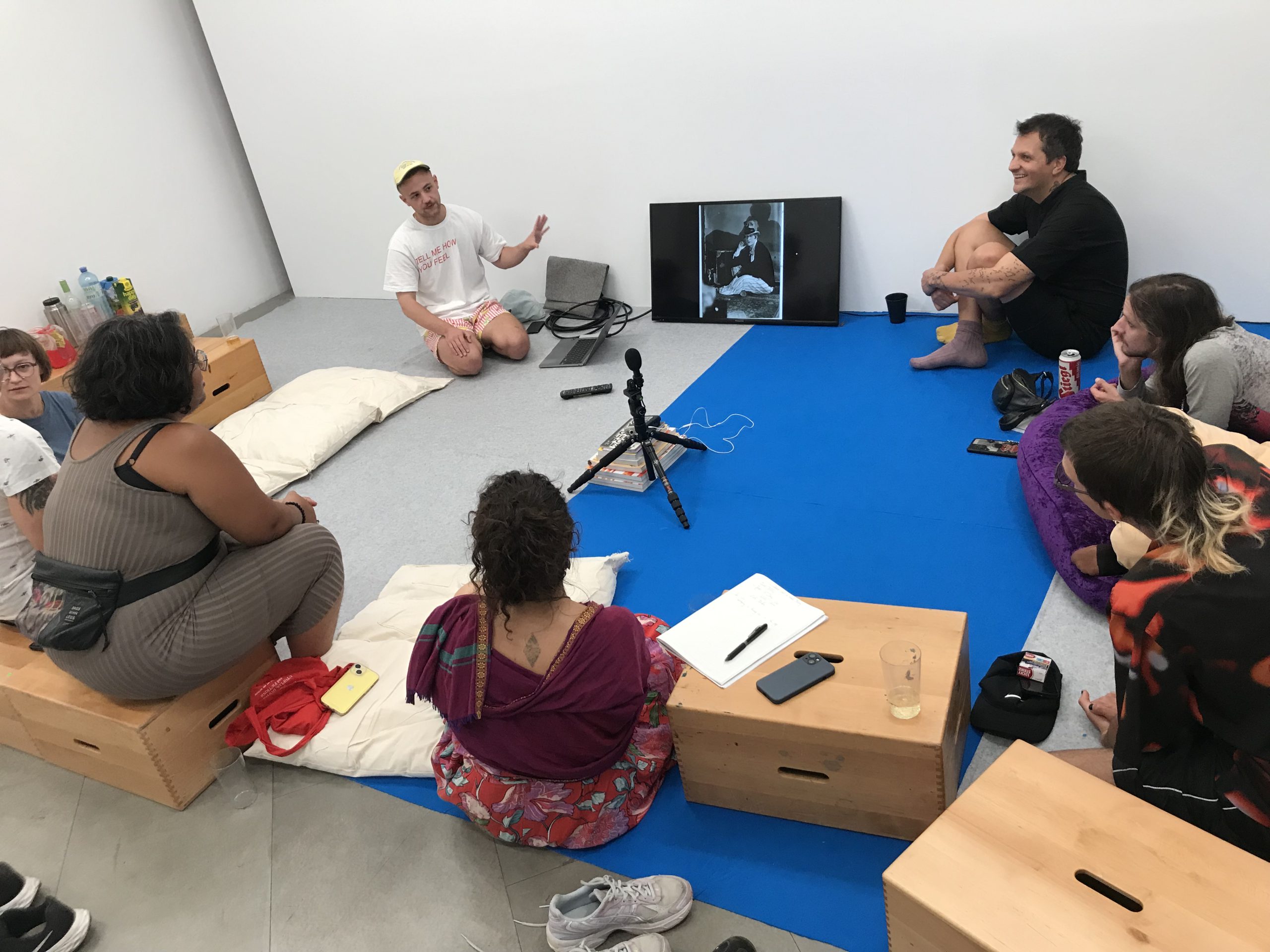
A still from the documentation of the public event, "A Fantasy Body," feat. Ari Ban (Sep 13, 2023), © Guilherme Maggessi, Rafał Morusiewicz
Table of contents
Last edited on: July 24, 2026
Premise
The first collaboration within our research project (Co_Lab #1) was designed as an ongoing workshop, i.e. a series of exchanges, meetings, and reflections among a small group of researching artists whose practices combine critical archive research with different forms of community-building activity. Culminating in September–October 2023, Co_Lab #1 ended with a sequence of four week-long workshops, followed by an exhibition at Vienna’s Exhibit Eschenbachgasse. In each week, we zoomed in on 2–3 artists/researchers participating in Co_Lab #1, dedicating each Wednesday for a public presentation, during which we would facilitate a context for an exchange between these artists/researchers and our Vienna-based friends and colleagues.
The following transcript documents the presentation of Ari Ban’s project on “queer gossip” and the follow-up conversation that took place on September 13, 2023. The transcript has been condensed and edited for concision.
Gossip as a research focus
Ari Ban: For a long time, doing illustrations was my main occupation, and also a very boring work for a magazine, where I have to draw things like “a pig that is dancing.” I always did comics, which often dealt with queer history. This is how the stories started to gather, at some point I had collected around 30 stories that needed to be told, mostly queer biographies. At some point, a friend of mine said to me, “Ari, this is your practice.” I started thinking of it as my work done through various outlets. Currently, I mostly write and draw. At some point, Mwoyo invited me to their festival to do a workshop about queer historical self-representation. I focused on how queer people draw and talk about themselves, as well as on what remains. I don’t like frontal situations, so I chose to follow a workshop format: I brought along a stack of lexicon and asked the participants to work on their self-portraits, while I talked. The idea was that people could shift between listening and doing stuff, they could choose to go in and out as they wished. This is also related to my interest in gossip. Everyone talks. Sometimes you choose to tune in, sometimes you don’t. There’s a conversation behind you, and you’re like “Mmm, they’re talking about this production… What’s going on there? They’re fighting!” Things like that. Some people don’t care about gossip.
I read a lot of autobiographies, also the ones that no one wants to read because they are bad literature. A lot of them are collections of letters, they are mostly written by white, Western-European “bougie queers.” These are the people that I currently do research on, because they are the easiest to access. I am interested in them also because the letters and diaries that get published are edited, which make me think of everything that is edited out. This is where, for me, art starts. That’s my thing. I’m interested in tiny details: that someone was known for eating a brioche everyday for breakfast. Bigger life events, such as inheriting a lot of money, are obviously important for a biography, but I pay a lot of attention to this weird little stuff that makes people plastic or three-dimensional. I am interested in multi-layered, multi-faceted stories. I don’t look for heroes or villains.
Hannah Gluck, Janet Flanner
Let’s start with Hannah Gluck, a painter and a butch perfection. On her Wikipedia page, it says, “We think that she was a lesbian.” In which world she doesn’t look like a lesbian?! She was the first correspondent for “The New Yorker” in Paris. She was an American in Paris writing about France for an American audience, particularly the bougie audience from New York East Side. She wrote mainly about people and cultural events happening in Paris, she was a gossip collector. Her writing is still available, it has been published in a few books. She’s not a great writer, but she’s interesting. She complains, for instance, that Loie Fuller’s dancers get paid too much, that they get sick leaves, or that this person always eats cucumbers. She would gather gossip, which, as was the case of Isadora Duncan, would become established myths about her. In this case, what initially was gossip about Duncan would ultimately exist as facts. And this begs a question: does it really matter what the truth was? That something happened exactly in this or that way? For instance, when Isadora Duncan would go to a party, people would assume that she was super rich and expected her to invite everyone. And she was not super rich. She was well-off, she could maybe afford partying for two days on her own, and then she had to find someone to cover all her partying expenses.
Guilherme Maggessi: I like these moments when a story surpasses a person, when it gets so big that it doesn’t matter if this person even existed. It’s also a narrative gesture, also when it comes to queer stories.
Ari: This is Janet Flanner, who came to Europe in 1921. She wrote for “The New Yorker” in 1925–1973. She was known for being wrong about a lot of things. For instance, she was a bit, but not enough suspicious of Germany in the 1930s. I liked that about her, that she was frequently wrong, but ultimately she would come around. She was also one of the main correspondents for the Office of War Information after the Second World War. During the war, she went back to the US for four years, and then returned to France, where she lived until two years before her death. Then she moved to her girlfriend’s place in New York. This is where her biographies are not precise, as they give consequent numbers to her girlfriends: her first girlfriend Solita Solano, her second girlfriend Noelle Murphy, her third girlfriend Natalia Danesi Murray. What they don’t make explicit is that all of them were her girlfriends at the same time. They were different relationships, but they happened simultaneously and lasted long. It was also rumored that Janet Flanner had a brief affair with Erika Mann. After she had moved to New York as an already older journalist, where she lived with her partner, she met Carson McCullers, who just arrived to town. Janet Flanner took Carson McCullers under her “queer” wings. Carson McCullers wrote a lot of long letters about how she was thankful to Janet for opening the door to her queer worlds. McCullers’s novel “Reflections in the Golden Eye” was supposedly written for Janet Flanner. That’s Janet Flanner and Natalia Danesi Murray, they lived together with Natalia’s mom and her son. That’s Loie Fuller, Claire Lefèvre is doing a project about her right now.
Erika and Klaus Mann, Gustav Gründgens
That’s Erika and Klaus Mann, children of Thomas Mann. With Klaus Mann, I have this funny relationship: every time he criticizes a piece of literature, I always realize that I like it. What gets forgotten but you can find out if you read all the letters is details, like the one that Klaus Mann was known for always wearing lavender shirts, it was his favourite colour. This gets forgotten also because textiles are not often archived.
Georgia Holz: Didn’t Erika Mann marry her brother’s lover?
Ari: Yes, Gustav Gründgens was Klaus Mann’s lover, whom Erika Mann married. And her brother was engaged to her girlfriend, who then married the father of one of their friends, who then wrote a book about “bougie shitty children,” which broke the friendship between all of them. These two couples were friends, and there was this play “Anja und Esther,” quite scandalous at that point in the 1920s. If you read the articles written about it, there are some beautiful words like “Girl-knabe.”
Gui: It doesn’t translate so well, but “Knabe” in German is an old word for an ephebe boy. And “Girl-Knabe” has this weird distinction. We have recently read a chapter from Renate Lorenz’s “Queer Art: Freak Theory” about “the gap and the deferral.”1 This word could illustrate the idea of a deferral word, as it encompasses two temporalities.
Ari: This group of four friends is interesting when it comes to arts, to being queer, and to fascism. Each of them chose different paths of engaging with being political, being an artist, and being queer. Gustaf Gründgens made a huge career in fascist Germany. Klaus Mann wrote a book about it, where one character is an actor whom Mann does not present as a gay man who is in relationships with other men, but as a straight man who has a relationship with a black woman. So he had this idea about his protagonist being an “other,” but chose to replace it with a colonial “other”: this happens a lot during this time in the white-queer colonial-European context. There are other interesting observations about being othered or being a minority at that time. Before 1918, there were so many small nation-states in Europe that a third of all European people were minorities in the contexts where they lived. In this sense, being a minority was quite usual. The word “minority” wasn’t popularly used though, and it mostly pertained to national and ethnic ideas. In the 1920s, the blooming “queer movement” appropriated the term to denote “sexual minority,” which makes me wonder: in what terms did a “queer” person think of oneself before that? Did “sexual minority” start being produced only then? Also, does the idea of “white queerness” overlap with the idea of a sexual minority, or is it thought of in different terms?
Gertrude Stein, Alice B. Toklas, Radclyffe Hall, René Crevel, and more
These are Gertrude Stein and Alice B. Toklas. Stein wrote “The Autobiography of Alice B. Toklas,” a faux-autobiography, where she, pretending to write in the voice of her life partner, states: “Alice met three geniuses in her life: Pablo Picasso, Alfred Whitehead, and Gertrude Stein.” And she means it! That’s Patricia Highsmith. All of her diaries have been published, and they are full of juicy stuff. She wrote Carol under a pseudonym (as Claire Morgan). Highsmith’s writing was first translated into Italian by Natalia Denise Morris. There are many connections between all these characters. There’s this story about Marlene Dietrich, whose girlfriend in Berlin in the 1920s was Margo Lion, wearing all black, pale, looking a bit like Dracula. She makes me think of a contemporary trope of a queer person that probably everyone has met: wearing a leather jacket, smoking a cigarette, standing in a corner, and not talking to anybody.
That’s Natalie Clifford Barney. She was extremely wealthy, had a villa in Paris. She sustained long close relationships, both romantic and not. She put great emphasis on friendship: she had a “temple of friendship” in her garden. She was into the Amazons: she would throw parties for only women who would all wear white dresses. She was problematic, as she hired Japanese servants, and people wrote about how these Japanese servants were “quiet and beautiful.” One of her love stories involved a painter, Romaine Brooks, who would then become fascist-leaning. This happened frequently with the people from the rich spheres that they would become politically problematic or opportunistic. Similarly, Gertrude Stein and Alice B. Toklas fared well during the occupation of France. Stein did not become publicly recognized as an opportunist figure because she died in 1946.
That’s Noelle Murphy, one of Janet Lanner’s girlfriends, she was a singer. That’s Radclyffe Hall, who wrote “The Well of Loneliness” (1921). And that’s Una Troubridge, what a name! They were known for having dachshunds. “The Well of Loneliness” was called the first lesbian novel, which, while not true, destroyed Radclyffe Hall’s career. The novel has a sad ending: everybody dies, love is unfulfilled. At that same time, the best-selling author in Japan was Nobuko Yoshiya, who wrote several lesbian fiction novels and herself was a lesbian. That’s René Crevel, a lover of Karl Mann. There is this story about how Janet Flanner and Solita Solano went for vacation in the south of France. They thought it would be so nice to go to a little hut at the seaside and do nothing. And then they realized, “I can’t cook, I can’t clean, I can’t do anything.” They were so wealthy! And they lived in a hotel most of their lives. René Crevel took over the little hut. Solita was Janet’s first partner. They stayed together for many years. She even moved in with Janet’s second girlfriend, they lived all in a “WG” in the countryside, when they were old. As far as I know, they all were friends with each other. That’s Annemarie Schwarzenbach, a very rich Swiss writer, who was deeply in love with Erika Mann. She also had a thing with Carson McCullers, as well as with Erika Mann, Pamela Wedekind, and Mopsa Sternheim.
Q&A Session (excerpts)
Gui: Now that we have looked through the photos you have brought along, I have a question about how all these stories translate into writing, which is your other practice, as you said earlier.
Ari: Magnus Hirschfeld’s “Berlins drittes Geschlecht,” for example, reads to me like a tourist guide for gay Berlin at that time. I found some poetic things in it, like the names that people chose for themselves: “The Morning Tower,” “The Fallen Star,” “The White Wall.” These are things that I am drawn to, and then I start writing around them. I start from the place of not knowing much about these people and about myself. In this way, I reflect on the question of how to tell stories with the “stuff” that is already there, but, at the same time, without knowing still that much. For me, it’s always about the question of the amount of transparency in what is invented and what is quoted. I use quotes, but I change them: I engage in wordplays, I paraphrase. In this way, I ask a question of what quoting means in the context of narrative and narrated history, which usually involves some dramatization. The texts I read were edited for the sake of dramaturgy and storytelling, which is done for the sake of readership. This is also a question of providing footnotes. You need to be clear and precise about how you cite things, which is obvious, because why not be transparent about the sources that one works with. I like extending the function of footnotes by including narrative comments that say, for example, “lol,” which I want to include just because I think that something is funny.
Gui: Another source of implied knowledge comes from exchanges, such as workshop situations. You once mentioned that it’s interesting for you to put things in relation to each other. For instance, when someone who lives in the 1930s says, “I picked up a phone,” then what does it imply? The same applies to different ideas of queerness and queer relationships then and now, in different time contexts.
Ari: I remember one letter where somebody said something like: “1943, I picked up the phone at home.” What does this imply? Does this mean you’re rich? How many people had a phone? What kind of phones would they have? Whom and how could they call? How much did it cost? How often did one do that? What did the gesture of “picking up the phone” look like?
Gui: This made me think of the time at the end of July, when I was reading through a lot of archival material, including letters. I was looking for something, I worked fast, I didn’t have much time. Now I think that sentences like this must have passed me by. This moment in our earlier conversation made me think, “I need to go back and pay attention to these.” These questions are super interesting to me. How did people navigate life back then? Some things may seem self-evident, but if you’re in the right mindset, you will ask yourself, “But what does this actually mean?”
Ari: This is also about ways to looking. You mentioned your friend who said about the “history of queerness” being criminalized…
Gui: Ari talks about Andreas Brunner from QWIEN – Zentrum für queere Geschichte, who said that “the history of the queer community is the history of persecution.” This claim comes from the context of building an institutional queer archive, which looks into institutional documents, such as those collected by the criminal police. This is how you approach quantitatively the question concerning numbers of people, their names and data stored in state institutions.
Georgia: This approach corresponds to the idea of the archive created by the colonizers, archiving mostly cases of enslaved people, who were just numbers in such archives. What you are bringing in is a perspective that is not often considered scientific. and not people. Also, what you’re bringing in is a perspective that is not considered scientific, which makes what you do so interesting. That approach to biographies, through storytelling based on gossip, offers a different perspective to telling history and approaching the canon.
Ari: I think people ultimately relate to that. Stuff like what Magnus Hirschfeld writes in 1904, “Don’t visit this bar, because straight couples from the countryside go there to look at the drag queens.” This means that a very excited ally like him existed already at that point. And this also constitutes cultural history. Another issue is that such findings about the past also help you question the idea that “queerness” is something very new. For instance, when Laverne Cox was on the cover of the TIME Magazine, people would say “The first black trans woman on the cover!”2 Meanwhile, there are German dance magazines from the 1910s, with black trans women on their covers. It’s not strange because when you realize at some point in your life that you are queer, the whole scene suddenly unfolds in front of you, and it takes time to uncover the queer pasts that are not widely known. I have a feeling that there’s also a lack of awareness of the continuity of phenomena like poly-relationships in queer contexts, which have existed way longer than in “straight contexts.”
Gui: In terms of personal archives, I am interested in the question of attention. What does one give attention to while compiling one’s canon of stories? To what extent is it necessary to understand how people understood themselves back then? Or is it more about how one understands them now? Also, what forms of kinship does one create for oneself? What I try to understand is how to make these different forms of engagement accessible to other people, that they are not only “personal” anymore, but become more widely social. I also recognize this wish to write a history that has not been written, and, through this, to acknowledge that it was always there, even though there was no scientific interest in it.
Selina: I am curious if you have found a way, other than workshops, to make these stories visible? Are you in the phase of wanting to present your practice, or do you focus more on writing every day and continuing doing research?
Ari: I’m bad at finishing things. I have been writing and doing comics for seven years now, so it’s been quite long. With the writing, it’s difficult for me to finish these stories, because each one opens door to so many things. My way right now is more artistic, relying more on abstraction, where language serves a different purpose than just making sense of everything. I am at the point where I cannot fully make sense out of these stories, particularly when it comes to the entanglement of white queerness with racism, to how much white queerness around the year 1900 was informed by colonial fantasies. It’s hard for me to access a way to talk about it through writing, which is when I choose abstraction: I quote or make a reflection around it, but I don’t make up stories anymore.
Footnotes
- 01 Renate Lorenz proposes a claim that “cultural products” (artistic works such as photographs) can “work as interpellations,” i.e. they can interfere “in processes of subjectification.” This means that a recipient of such a work may enter a formative relationship with what the work represents, manifests, or “interpellates” in them. Lorenz analyzes “queer-artistic practices” that are “in the position to break off interpellations, producing a temporal and spatial distance – a deferral and a gap – between an experience and any possible effect on the process of subjectification.” For instance, works that “thematize embodied categories such as gender” do that by “tracing their history and making them non-self-evident,” without “offering” these categories “up to identification” but instead making “material beyond gender available for reflection and experimentation.” Renate Lorenz, Queer Art: A Freak Theory (transcript, 2012), 18.
- 02 Laverne Cox's Time cover is the topic of this editorial: https://time.com/collections/a-century-of-impact/6258454/laverne-cox-interview-transgender-tipping-point-cover/.