Conversation: Archive of Palimpsests, with Vlad Beronja (series: Co_Lab #1)
Last edited on: July 24, 2026
Premise
The first collaboration within our research project (Co_Lab #1) was designed as an ongoing workshop, i.e. a series of exchanges, meetings, and reflections among a small group of researching artists whose practices combine critical archive research with different forms of community-building activity. Culminating in September–October 2023, Co_Lab #1 ended with a sequence of four week-long workshops, followed by an exhibition at Vienna’s Exhibit Eschenbachgasse. In each week, we zoomed in on 2–3 artists/researchers participating in Co_Lab #1, dedicating each Wednesday for a public presentation, during which we would facilitate a context for an exchange between these artists/researchers and our Vienna-based friends and colleagues.
The following transcript documents the presentation of Vlad Beronja’s research practice both in and outside the context of this research project, together with the follow-up conversation, that took place on September 20, 2023. The transcript has been condensed and edited for concision.
Academic background, research interests
Thanks everyone for coming. I’ll talk a little about my research and academic background, and then I will transition into how I see these practices and this experience in relationship to the former. The idea is to keep this presentation as an open dialogue. One of the things that resonated with me during this workshop is the focus on the process rather than the outcome, together with the collaborative nature of the process. Gui, Rafal, and the other participants created a pedagogic space, where it was great to see the resonances between different people’s works, as well as what came out of the workshop. My presentation is about the object that I brought to Split in June as part of the “personal archive” setting, as well as about the ways in which this object has transformed since then.
I work as an assistant professor at the University of Texas at Austin. I’m a literary scholar working with text and visual materials. My focus is contemporary art and literature from former Yugoslavia. In particular, I am interested in the counter-archival practices related to the memory of socialism in Yugoslavia in literary and visual works. I deal with questions of affect, nostalgia or “Yugo-Nostalgia,” mourning, and melancholia, in relation to the socialist past, to the ways in which the past is still present through traces, recollected in various forms by artists and writers. I consider this practice as an act of suturing the traumas, ruptures, and rifts that originated through the wars in the 1990s, through the fragmentation of Yugoslavia and the transition from market socialism to capitalism and contemporary neoliberalism. I’m interested in asking questions concerning form and medium specificity, which give these traces their various expressions, be it textual or visual. I am also interested in the circulation and translation of these traces across the former East-West divide. There are many writers and artists working across these borders. I will present a few examples that have been particularly inspiring for this project, as well as, specifically in the literary context, for the ways that these memories appear, sometimes, for the first time, only through translation. What is important to understand about this context is that the 1990s was the time of a radical breaking away from the socialist legacy and the erasure of the memory of socialism, which took the form of purges happening in archives and libraries. Across the libraries in former Yugoslavia, books written in Serbian Cyrillic were trashed. Some archives were cleansed of any material that was about the Socialist period. It was simply an erasure of history, and I am interested in literary and artistic counter-archival practices that address this erasure. In 2016, I co-edited with a colleague, Stijn Vervaet, a publication Post-Yugoslav Constellations: Archive, Memory, and Trauma in Contemporary Bosnian, Croatian, and Serbian Literature and Culture, which discusses contemporary artistic and literary practices in former Yugoslavia. Also, I’m currently finishing a book manuscript that relates to these counter-archival practices.
Dubravka Ugrešić
One of the writers that I focus on is Dubravka Ugrešić, who passed away in March this year. She was a diasporic writer, who moved to Amsterdam in the 1990s, where she lived in self-exile. In 1997, she published The Museum of Unconditional Surrender, a novel that takes place in Berlin and is staged like an art installation, inspired by contemporary artistic practices of that time. Ugrešić’s work has always been in dialogue with the visual. Toward the end of her life, she also did some visual artwork. She was interested in preserving traces of socialism, as well as their reconfiguration in the present, so she paid attention to the objects that carried socialist experience and cultural memory, as well as the ways in which they would interact in contemporary contexts, both in and beyond former Yugoslavia. I’m interested in the temporalities that her work evokes.
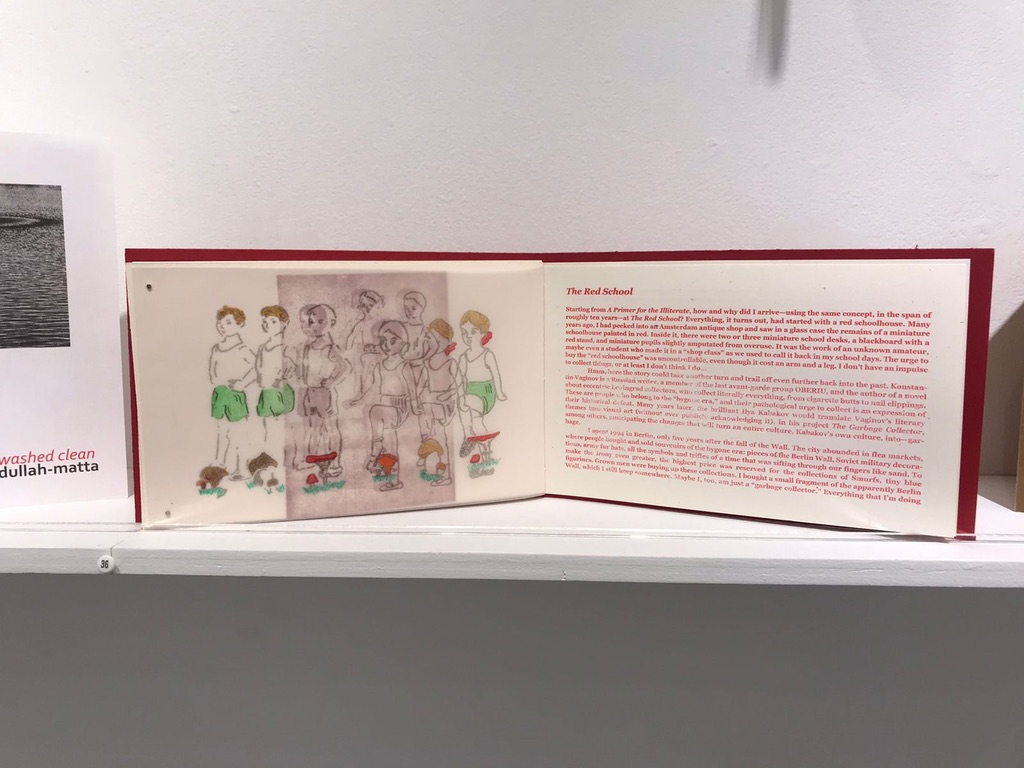
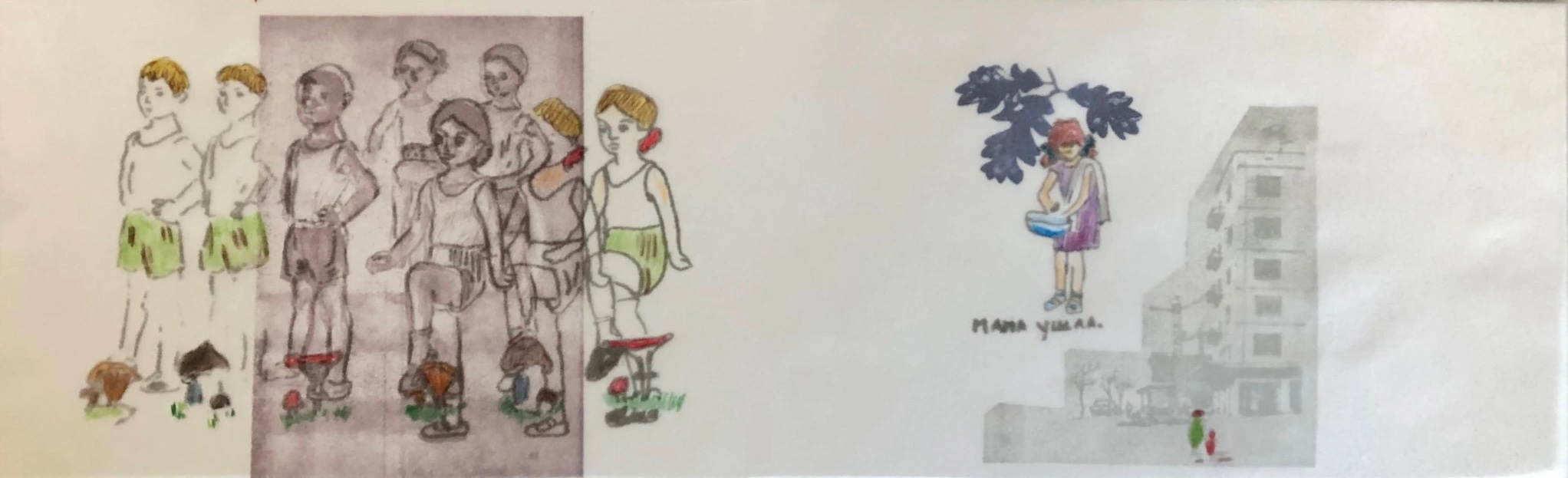
Ugrešić made collages and palimpsests out of school primers published in Yugoslavia and other former socialist countries in the 1950s. She overlaid the original images with tracing paper and did visual interventions into this iconography. You can see, for instance, that the little girl, i.e. the image that recurs, is something that she traced on tracing paper, creating this palimpsestic effect. Her work references the magic writing pad, which Freud considered to be a metaphor for consciousness. She also did boxes, where she used now-forgotten slogans repeated in schools and other institutional contexts in the Socialist era. She combined them with other scenes, figures, and iconographies. Me and my friend Megan Forbes, who ran a small press called harlequin creature, asked Dubravka to prepare the American edition of The Red School. We printed some of these collages on letterpress and risograph. The Croatian edition of The Red School exhibition catalog was just reproductions and photographs, but we managed to keep it interactive and preserve the palimpsestic integrity of the object. This is how this little book got put together.
Aleksandar Zograf
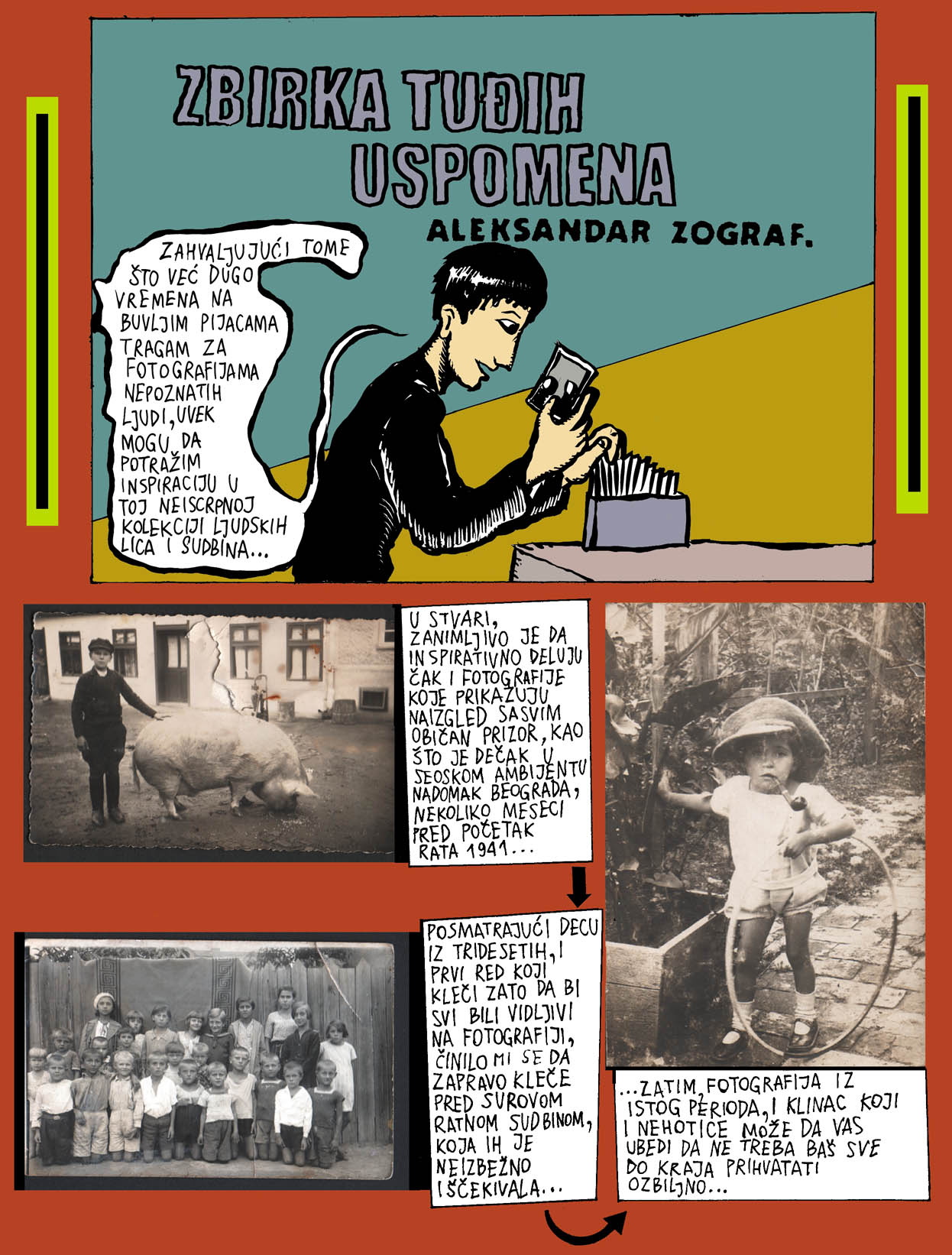
Another artist that I worked with was Aleksandar Zograf, which is a pseudonym of Saša Rakezić, an alternative underground cartoonist. He’s published a few collections of comic-strip stories about the objects that he had found at flea markets in Serbia and former Yugoslavia. He finds photographs, for example, and, on their basis, he creates fictional narratives. He sees these photographs as “haunted” in many ways; some of them relate to World War II and the post-war context. He evokes photographs as a medium in a “true sense,” i.e. as something that has an agency to transport or to communicate the past, to bring it into the present time. As you’ll see, the kind of work that I’m doing, or that we’re doing in this context, was inspired by an idea of archival refuse, of archival discards, of non-conventional archives, like trash heaps or flea markets, as well as of using discarded objects and re-contextualizing them in new ways.
Personal archive
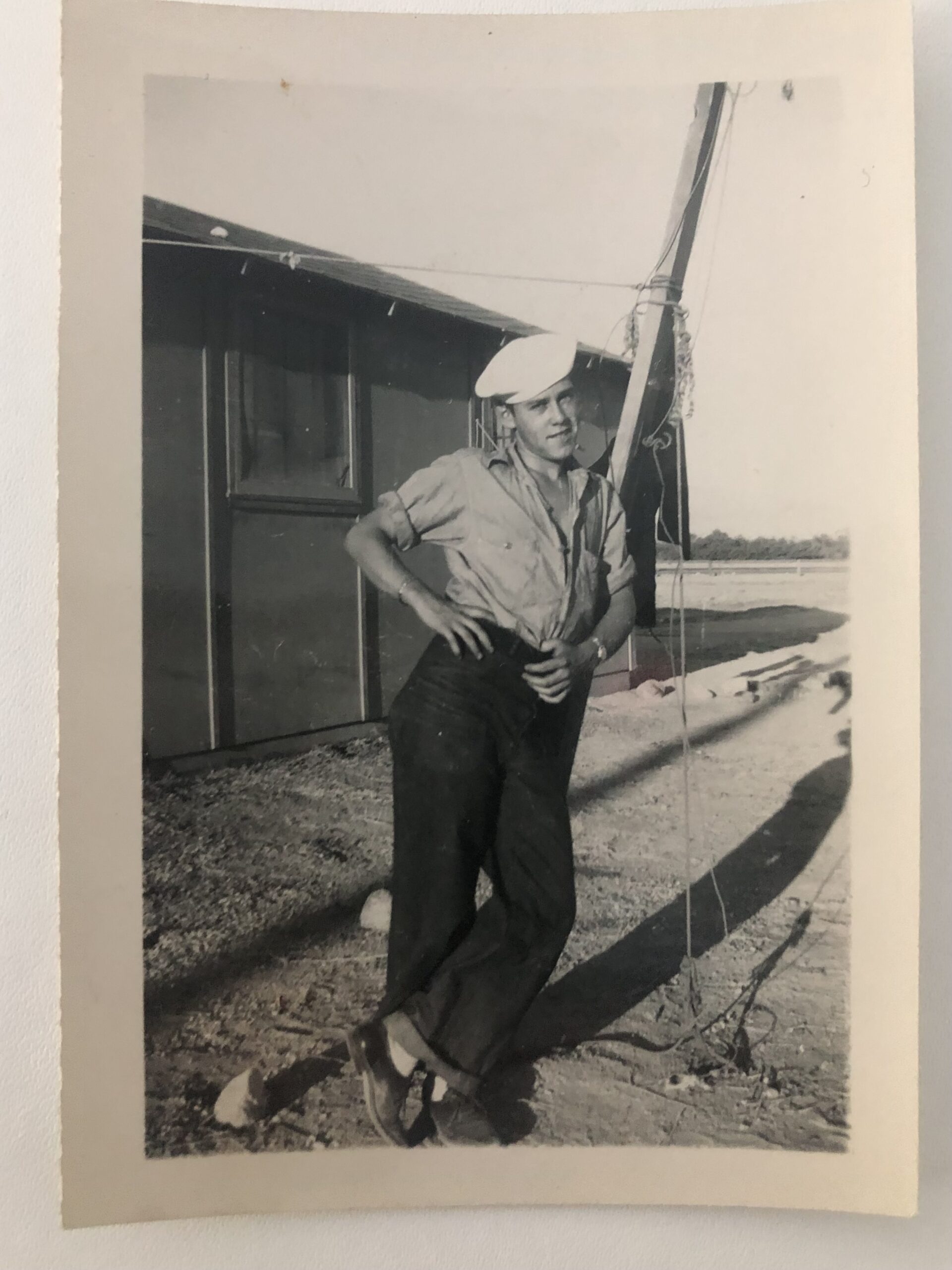
My object is a set of 10 black-and-white small-format photographs in a small envelope, labeled “Luke” and “Navy” or “ex-Navy,” I don’t remember exactly. The photos, dated 1945, portray men recently discharged from army service. They were taken in different places, California, Colorado. I found and purchased them in Round Top, a big antique fair in Central Texas. They were part of a rummage sale, so I thought that this was my way of “rescuing” them. At least, that was the initial impulse. There are so many photographs like these at the rummage sales and vintage shops in Austin or Texas.
When I brought the photos to the workshop, I asked myself: why this particular object? I was drawn to this set, which makes it personal, but, since these are other people’s photographs, it’s also impersonal. There’s something both generic and unique about these images. I had to think about what exactly drew me to them. They are aesthetically pleasing. They depict homosocial bonds between men, so there are homoerotic undertones or subtexts to them. At least one can read into these things, which I certainly did. They have some whimsy in them: there’s this cockatoo in one of them that I was really charmed by. I love the format, their small size. I also love the posing in some of them: there’s this one sailor who poses to the camera, and there’s something very iconic in this image; it made me think of the sailor iconography in popular and queer culture, where the figure of the sailor is present in Jean Genet, Jean Cocteau, and Querelle, Fassbinder’s take on that sailor myth.
Exhausting objects
During the workshop, we did an exercise, where pairs of objects, together with the people who brought them, would be put in a dialogue with each other. That was part of the task of exhausting objects, i.e. finding different ways to “configure” the objects. In this exercise, I was paired with Mika Maruyama. Together, we created a map that traced the ways that each of our objects traveled. In this way, we identified possible connections between the two objects through such geographical mapping. The more I was engaged in that process, the more ambivalence I developed toward both the photographs and what it represented. I thought about the context in which they were taken, about the ideas behind the American military. The way that this object travelled, from Texas to Split, relates to my personal history of being a refugee from former Yugoslavia, who years ago ended up in the United States and only recently reconnected with this past through the workshop in Split. That was a journey for me, and it’s fascinating how all of these histories have come back and merged together.
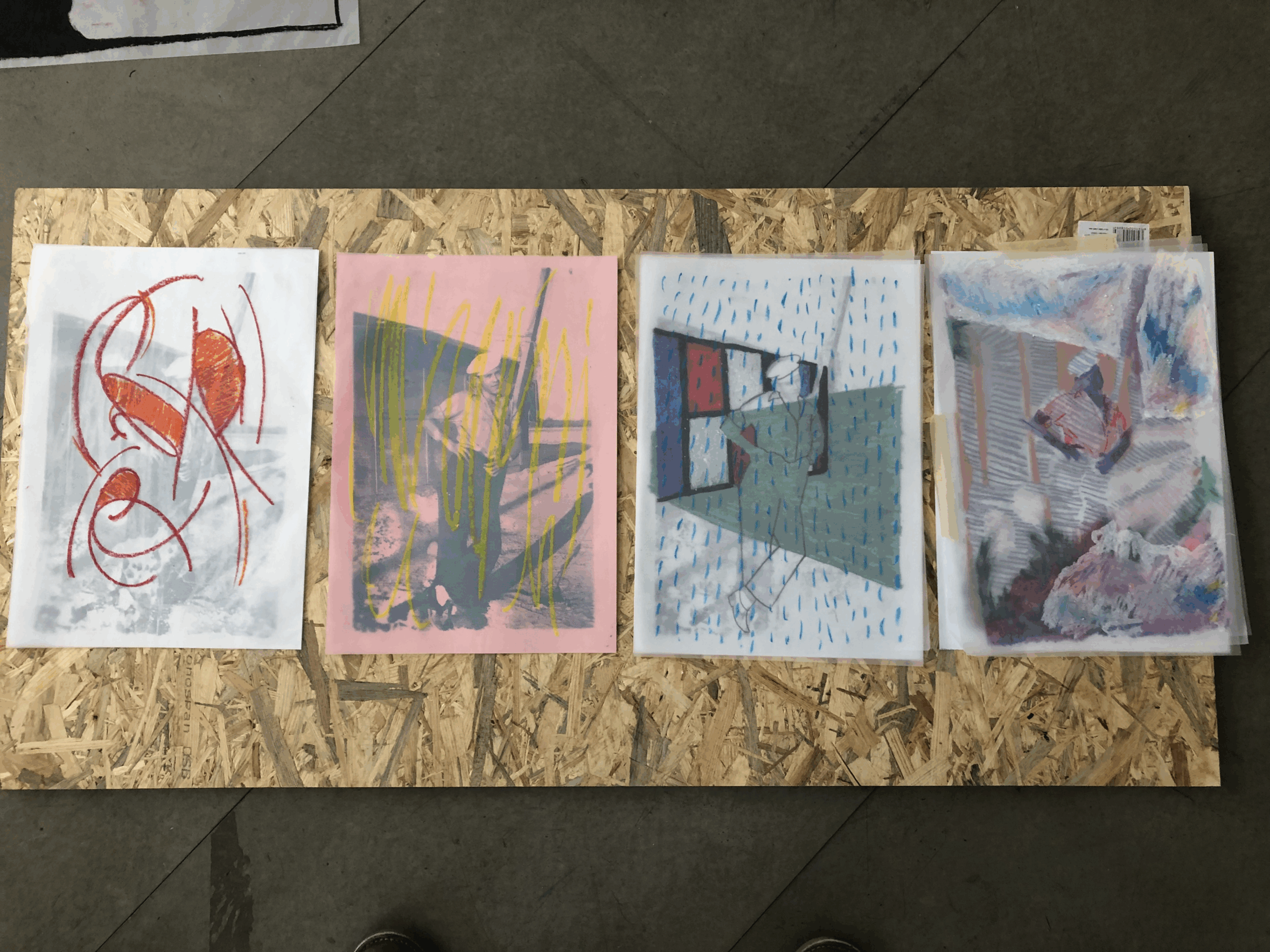
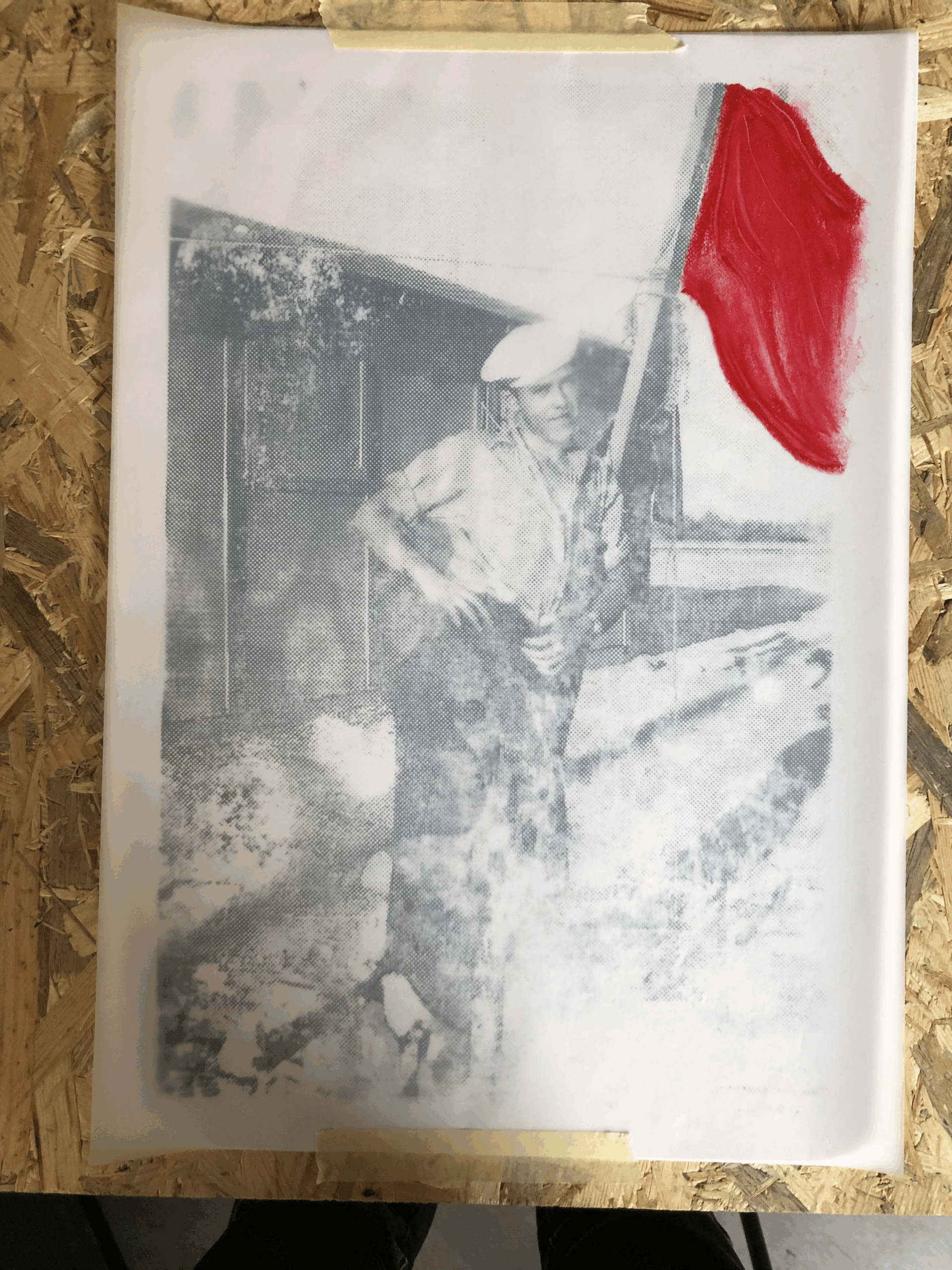
One of the spaces in Split, where part of the work on “exhausting” my object happened, had a printing studio, which I took advantage of. I chose one image that I thought was the most iconic in the whole collection, and I started reproducing it. I worked with Tonči. I was curious what my intervention could be and what relation I would build to this object. I created a screen, I started multiplying it. It was quite a large print, so it required a lot of ink, which would dry up quite fast, so the screen would gradually lose its integrity. The more I kept printing, the more I liked the idea of introducing visual noise into the image. I found it to be a good way of signalling my ambivalence, it also corresponded to the conversations that we had around archives, particularly the ideas of permanence and fixity, memory and forgetting. I was curious how the repetition of the same gesture would create a difference, how it could open up blank spaces, onto which the viewers could then project their own meanings. In a way, this image has a limited context: it is historically situated, but it’s appropriated out of its historical context. So I thought upon coming to Vienna: why not go even further with these interventions? Why not unfix the image from its original context even further and bring into it the personal histories that I had been thinking about this whole time? This begs questions about the ethics of such a decision, which we can talk about later too.
A comment from Guilherme Maggessi:
I mentioned Rajkamal Kahlon, who had an exhibition at Kunsthalle Wien. She’s an American-Indian artist who goes through ethnography books, transfers them, and then cares for the images. There are a lot of ethnographic depictions of children who are undressed or being sized. She creates different images and imaginaries around these depictions, using a similar type of transferring or painting on top of them, which turned out interesting as a strategy for us.
Exhausting the object
When Gui mentioned her practice, a light bulb went off in my head. I thought that we could use, or appropriate, these methods, I am familiar with them. We can use them to interact with the writers and artists I’ve already worked with, and we can be open to experimenting and seeing what comes out of all this. I wanted to continue with the multiplication of images, with this form of making a palimpsest, which related to my experience of migration, with the superimposition of one migratory context over another. In the images we created, there’s a rupture between the background image and the image repeated through tracing paper. There’s an interaction between them, a doubling effect, which reminds me of diasporic and immigrant writing, where there’s a double exposure out of the superimposition of our histories and our plural pasts onto the present. I wanted to bring into this image the context of former Yugoslavia, of Eastern Europe, of the socialist past, and, in this way, to de-center its U.S. context. These images show how we have been playing with the form. In one image, for example, I decided to include a very iconic Adidas jumpsuit. When my family migrated to the US, my mom bought identical Adidas jumpsuits for my brother and me, she bought them on credit, which she had to pay off in instalments. It was this high-priced piece of clothing that we brought along with us to the U.S. We thought that we were the coolest.
It turned out though that it was just a mark of our difference. Then kids started making fun of us because we would wear these jumpsuits every day for weeks until they told us, “You know what? You need to get new clothing.” But it’s still an iconic fashion item of the Eastern-European immigrants, especially related to the working class and lower socioeconomic standing, with Adidas being this prestige brand, at least in the context of Eastern Europe. When you move west, it loses that kind of prestige. And then I thought, I have to include the international communist flag as well, which is related to the iconography of the sailor coming from the East, also present in Battleship Potemkin, Eisenstein’s film. Bringing these contexts into this image disrupts it in some ways, adding different meanings to it. We’re still thinking about what form to have this in. Is it a book? How many layers do we exhibit? How do they interact with each other? I love this dandification of the sailor with the red beret, I think it’s really lovely. This was just me playing around, this is a quote from Battleship Potemkin, so we don’t know if this is the final form.
Another thing that came to my mind in this context was Gayatri Gopinath’s work, who writes about the aesthetic practices of a “queer diaspora,” a term that she investigates in her book Unruly Visions. She defines it as visual practices that engage with questions of migration, gender, and sexual formation. She argues that these practices give us a queer optic, one that allows us to see differently, to see different connections between various formations that historically were obscured in conventional historiography. I’m interested in this relationality. I’m not sure if these are historiographical in any way, but certainly they create a layered visual language that is about diasporic or migrant archives, and about the ways that they disrupt conventional archival formations. That’s where I’m at. Thank you.
Q&A: Seth Weiner
What I find exciting about this work is that, for instance, when you do the erasure of some of the elements, we can see the repetition, the gaps, the fissures, and the dissolving of the actual tool that you use. And then it becomes something else. The image gradually softens, you apply this bourgeois color, and the context, the original place and its history, becomes more of a ghost. While in some others, the image is clear: the facial expression, the overall figure, this kind-of-like contrapposto pose. The image feels like an oil painting. This does interesting things to the gaze, which sometimes makes me think of lifestyle or fashion magazines: here’s this American sailor, you know? You can’t underestimate the effect that adding color has.
Q&A: Vlad Beronja
Red, for instance. Yes, thank you. I love when all the layered elements dialogue with each other. This is when abstraction comes out, when you get to see the composition of the original image, with the classical pose of the protagonist.
Q&A: Audience member
The way you talk about your thinking process makes me think of situations in which I am drawn to an image. This may have happened to some of you too. You see an image, a photo, somewhere at a flea market, and you buy it because, for some reason, you feel drawn to it. Then, after a year or so, this affect is already gone, but, by interacting with the image, you can still remember yourself at that past moment in time. What’s interesting to me is that the way you work with these images is like performing thought. This reminds me of an essayist process, where it’s the form that speaks, while the thinking process is embedded in the form. Or maybe it’s “the form that thinks.” That’s why, I’m critical of your decision to include text in one of the images, because this breaks the emotionality of your visual reading with propaganda language. I prefer when you use only images, because, for me, they are more universal.
Q&A: Vlad Beronja
I think I agree with you that using text anchors and determines the image. For me, it was an experiment. When I placed the text in front of the red flag, I thought that it may have anchored the image too much. I appreciate your comment about the essayist quality, the openness of form, and the thinking through images, through drawing.
Q&A: Claudia Slanar
I actually like this text here. It makes more sense here than if it were combined with the red flag. You do what a good collage is supposed to do, i.e. to bring in different systems of signification. There’s a weird confusion of signs, some of which are language, and some others are color, the form, and the effect of layering.
Q&A: Seth Weiner
I think that if there was no text here, then the image would feel closer to the idea of a “personal archive.” The addition of the text creates a genus in this collision of signifiers. There’s a language that develops visually, one that is harder to grasp, because it’s not as literal as some of the other images.
Q&A: Guilherme Maggessi
Speaking of “making sense,” I thought of a text that can be an interesting reference: “Queer OS,” as in “queer operating system.” It talks about how the process of making sense of something is based on “common sense.” This begs a question about what happens if we make sense of something, basing on an “uncommon sense.” I love this idea. I feel that our conversation has developed in this direction. Do we have to make sense of all this? And, if you think that we do, then what exactly is the “sense” that needs to be made? If it is “common” sense, then what is it exactly?
Q&A: Claudia Slanar
Where i join you is in that point about the way of finding hints, of sneaking into the image and trying to find what you want to retain from the first encounter that you had with the image. On one image, you don’t do anything to the original image, then, on the other, you add a beret. It’s like over-interpreting something that isn’t really there in the image, but you still read into it. I find this subtle way of exaggerating hints really interesting.
Q&A: Serena Lee
The idea of being stuck with an image makes me think of fan fiction, a genre that follows and alters an established fictional universe. There’s something interesting about such proliferations, about getting sunk into the signification of a particular history that’s already fragmented. You approach this specific image from a place of possibility, and you open yourself up to the process of navigating gaps between the image and your fantasy. That’s what makes this form open. It’s fun to see how each image gets weirder and weirder. If I had only seen the original set of photos, I never would have expected them to go where you take them. The first image was still quite literal, you pasted a few elements onto the image. And then the next image becomes more surreal, it’s like a watery collage. It’s as if this ghost, this bizarre entity appeared immediately.