Conversation: Archive of Dance History Erasures, with Claire Lefèvre (series: Co_Lab #2)
Table of contents
Last edited on: July 24, 2026
"Institutional eye candy"
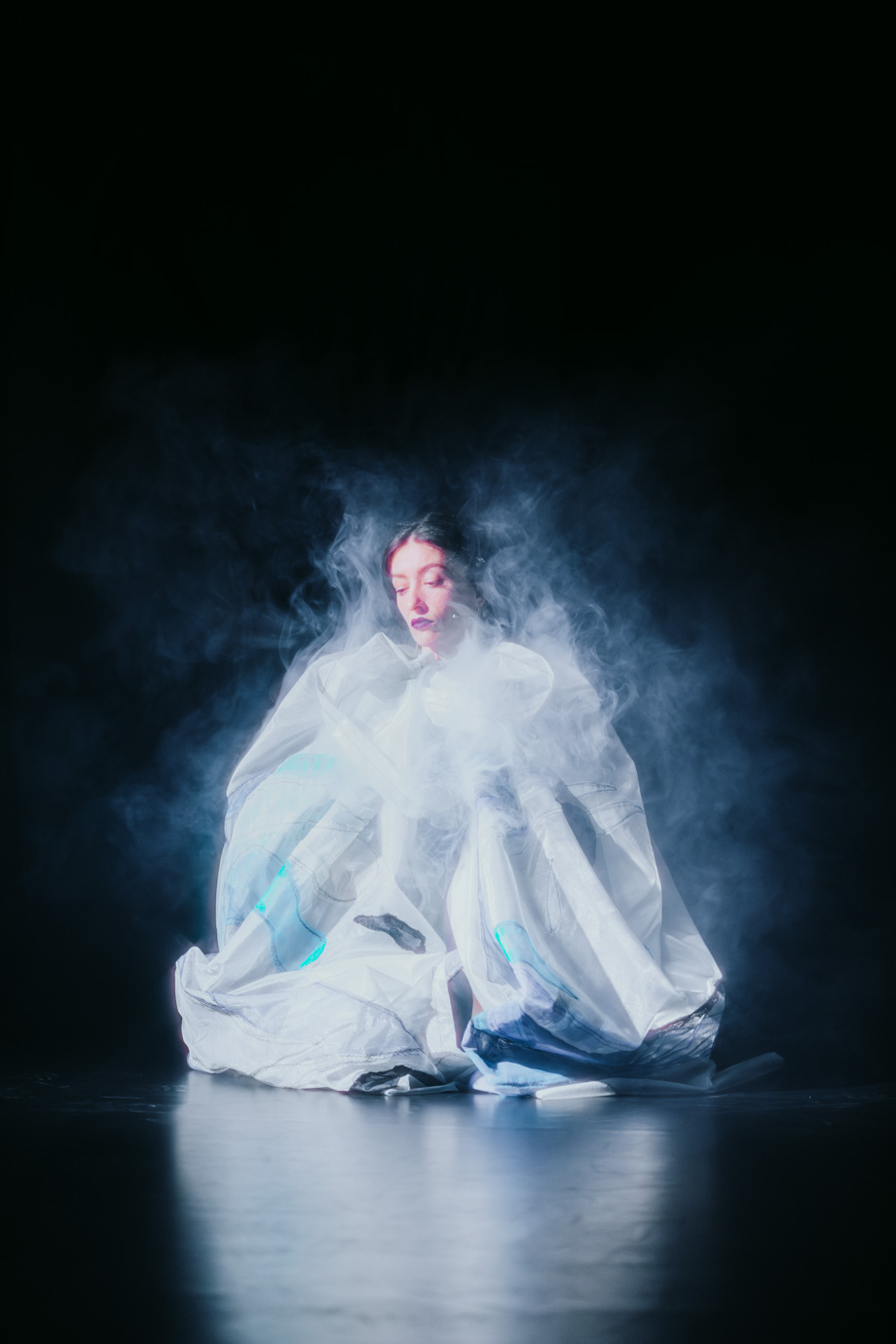
Documentation of the "Loie" performance, © Hanna Fasching
Claire Lèfevre
…I heard that aristocrats would hire actors or people to play the roles of hermits in their garden. They would live there and be there just for the vibes. They were not allowed to cut their hair or nails. People could approach them and ask for advice, they would get paid, or at least lodged and fed. This is such a great way to sell an “artist in residence” program! I would be happy to be able to live at Studio Brut for two months. I would bring a little garden shed, and I would read in peace. If people wanted to come, to show me their concepts, or to talk about their heartbreaks, I could give them advice. I would grow my hair or wear a really long wig and just be there.
Guilherme Maggessi
That’s a great idea. Smaranda Krings and Justina Špeirokaitė from Question Me & Answer make themselves available every month at Kunsthalle Wien.1 They sit there for an hour at a table, people can come and bring questions about being an artist.
Claire
It’s also like being an institutional eye candy, their decorative schmuck. It’s a way to reclaim the idea of being “in the collection of artists,” representing whatever it is that the institution does. These days I have a lot of ideas that make me think [whispers] “I’m a genius.” But seriously I think it’s a cool idea.
Rafał Morusiewicz
I understand that. Earlier today, I also felt that “I am a genius,” after I managed to pull off one gimmick in a video I was working on. I had an idea of an effect I wanted to have, I thought it would be super complicated, but then I tried something easy, and it worked! I was super proud of it.
Claire
We need such stuff to just keep going.
Gui
To experience an effortless success…
Rafał
What do you mean by “effortless” [laughter]?!
Gui
No, of course, you’ve worked all your life for this moment [laughter]…
Rafał
I will also not have my “genius moment” dismissed. But I understand what you mean. It’s this idea that surprises you because, after it works, everything seems smooth and easy.
Claire
Exactly! That’s what I like. I feel that since the Loie piece I haven’t had even one idea. I was so drained. I’ve had nothing.
Gui
She took everything from you?
Claire
Yes! It’s the first time that I had this excitement of “nothing is yet a problem”! It’s great: everything is possible, you just have ideas, there are no conceptual conundrums. It’s such a nice place for your brain to be in. Of course people will want to come. Of course it will be nice. I will build some fake-ass little garden with tiny plants and fake grass.
Bodies as storages

Documentation of the "Loie" performance, © Hanna Fasching
Gui
It makes me think of this red grass-like carpet that we once bought for an exhibition piece that we invited Mzamo to do.2 It’s great, there’s a nice selection of colors, and it comes with a built-in stopper underneath.
Claire
I usually see this “British garden” grass, totally fake, which I also love. There’s this book about how kitsch is connected to the invention of glass blowing, to all these dust-collecting surfaces: aquariums, snow globes, fake grottoes with fake mermaids. This aesthetics makes me think of the British garden.
Gui
That’s a great lesbian art history moment, because Virginia Woolf’s partner was a garden designer, a landscaper.3
Claire
Really? I didn’t know that! It’s funny because everybody sends me stuff to read that they think is somehow related to “Loie.” I do this a lot too: people come to me, and I offer my reading recommendations. This also happened in the context of “Full Melt Down,”4 where people could come and just hang out without doing anything specific. You could simply come and read, for instance. I was told that it would have been great if this event situation could go for longer than just three hours, that it would be great to have such a space for one month, so that you could read the whole book while being there. in terms of continuity, this would make sense also for me, because I could recycle and try out some stuff that I already did. And there would be time to do some silly little garden gnome fantasy. It’s such a great thing. I would totally like to be this old lady with a little garden, full of ugly garden gnomes and plastic sheds for children with slides.
Gui
This garden thing reminds me of a course that I took a few years ago at the Academy of Sciences, called “Gender Landscapes Studies.”5 But let me try to do a transition to what I thought would be the focus of this conversation. Before our meeting, I looked at “The Fuller Picture,” the online publication on your website, with Loie Fuller’s picture on the cover.6 There, you have this text, a letter that ends with a line, “Who would have thought 17 years ago…” I don’t want to be this creepy interviewer who quotes things back at you.
Claire
It’s okay, I haven’t engaged with this text closely for a while, so please remind me what I wrote.
Gui
I’m thinking of situations when you write something, and then come back it after so long that the “you” who wrote the text doesn’t feel “you” any longer. We actually talked about it with a few friends yesterday, and I like how one of them (Annette Kraus) phrased it: “I was in a mindset that I was able to think like this.” But anyway, it’s a loose association, let’s go back to your text. You wrote: “Who would have thought 17 years ago when we met for the first time you and I would wind up here?” This made me think of the question that recurs in this round of conversations, concerning the “detonator” that jumpstarted this project. Did you feel that you had a relationship with Loie Fuller before the project? What did your project emerge from?
Claire
The earliest thing I remember learning about her was probably when I was a teenager and had a feeling that she was odd, also in the dance history context. She was never about virtuosity, she didn’t “look” like a dancer in the traditional sense. She was not so much about the body. I remember being intrigued by her hyper-technicality, which was somehow more about the theater of the body than about her body being important. I remember thinking that this was cool. And then I forgot about her, I don’t know why. I did dance history as my major in high school. We did everything, from ancient Greece to Pina Bausch, everything, of course, meaning the European, Western, white dance history. She was an important turning point. I was aware of her, I remember being intrigued about her, but then I let that feeling go.
Then I got older. I came out. I started asking questions about the “femme” representation or non-representation, about the invisibility of the lesbian body in the dance world. Although the dance world is very much about the body, it’s still not much different from everywhere else: a patriarchal rather-macho bubble. Even though there’s a majority of cis-women, at least that’s the case of the ballet school environments where I grew up, there’s always this one boy in the class who gets a lot of attention. Such boys get to do all the big jumps and all the complicated turns. And they progress really fast, because they don’t have 15 years of low self-esteem or people telling them that they’re garbage, so, eventually, if you are constantly put on a pedestal, you progress “weirdly” fast [laughter]. These questions had been around me for a long time. And then this article popped up, I don’t remember where, maybe on Instagram, about Loie Fuller being queer and about her work being so queer. This may have been my a-ha moment, I got very excited. I can relate to the ways in which she worked, because my practice, especially recently, is about hosting, is about using the theater apparatus as a way to create an experience that can be sensorial. She’s very central, though her body isn’t. I found that really relaxing, because I have a similar approach: I invite a lot of people, and my hosting practice relates to different fields of what I do. I am not very interested in the virtuosity of this hyper-capable body. I think I put my skill range elsewhere, like creating an atmosphere where people can also experience their own bodies. I’m also a big fan of the “magic of theater.” If a smoke machine is on, it never ceases to amaze me. Something about the combination of nerdiness and the magic that is super technical is super cool. I know all the tricks, but the tricks still work on me.
This is also why I still work in theater and not in galleries. Even last week, which was super stressful, the moment I found myself in a black box, my whole body, my nervous system relaxed. The black box feels very homey. This has something to do with a complete lack of awareness of the time passing that I find so relaxing while being in a black box. It’s a parallel bubble. Of course, it’s completely naive, because all the structures of the outside world are within the black box. Even more, they shape it to a great extent. But still, even if only for a moment, it has the capacity of becoming a space that allows one to create an alternate reality, or an illusion of an alternate reality. Or to practice alternate realities. Loie was one of the first makers to use the black box as a format, so I felt excited about it. I think I wanted to see myself in this history. This desire to project is a very tempting thing, despite all the problematic issues involved in projecting today’s queerness on the “deviant” bodies of the past. And it’s also immediately disillusioning. At that time, I was excited because I could see a lot of myself reflect in her, including some parts of myself that I didn’t want to see in her, but yet they were also there.
Rafał
Would you mind talking about them?
Claire
Sure, but I don’t know if you want me to just talk more about that or…
Gui
Maybe before that, I would still like to ask you about something that you said earlier: about the phase of the project where “there weren’t yet problems.” I am interested if you recognize something now that made you in retrospect excited about the project, something that existed before the “problems” appeared?
Claire
I knew that, to some extent, the colonial history of modern dance would be a topic in this project. Addressing this history seemed to me exciting, but I didn’t realize to what extent this would move to a central position. That, in the end, this project would focus on me trying to figure out if it’s even possible to bring the figure of Loie into the current times, on what it means to work intensely on somebody who turned out to be so deeply problematic in today’s standards. I went through a bargaining phase, which is present in this piece, when I tried to make up excuses for her: “But at that time it was different! Maybe she didn’t know?”
I experienced all stages of grief and finally came to terms with the realization that I didn’t know if it was okay to make this piece. I came to terms first with not knowing how to make this piece, and then with how not to make it come off as too easy. I didn’t know until the last moment if I would manage to do what I wanted to do. I definitely knew that I wanted to do some kind of a lecture performance, an exciting format that I had never done before and wanted to engage with. I faced a big question of how much I wanted to “go abstract,” trusting that all the questions I had would anyway be present in the room. At the same time, I was aware that getting to be abstract about things is a matter of privilege, which I didn’t want to grant myself. Some people have to deal with such issues first-hand, without being able to afford the luxury of abstracting them from their lives.
Many such questions came up during the creative process with Sunanda Mesquita. Who is this piece for? Who will be triggered by this content? Who doesn’t need to be in the room, while we unpack years, and decades, and centuries of colonial history within the dance history? I also realized that many people probably don’t know much about the dance history. This, for me, was also exciting, “Okay, we’re starting from level zero here!” This opened a wide range of possibilities. There’s not much pre-conceived general knowledge of dance history. I guess that if you asked people to name five famous composers, they would immediately come up with Mozart, Beethoven, maybe Vivaldi and Bach. But if you asked them to name three famous choreographers, this would be a bigger challenge. Most people would probably know “Swan Lake” or could name some musicals, but they would probably have no idea about who made them. This brings an interesting question of authorship in dance, which is such a collective art form, it’s never just one person doing everything. That’s also what makes dance so cool! Besides, I was also excited about the prospect of doing this epic piece, which would talk about gender and lesbians, that would tackle some mild questions, and I didn’t think that this would actually involve deconstructing everything that I had ever learned.
This project brought about a big question about what it meant for me to be on stage, together with all this history stored in my body. What does it do to a space? How is it read? It was a challenge. I’m happy to have had a team of people who pushed me until the last moment, who helped me not run away from the challenge. Your question makes me think of what Sunanda said during the process: that if I didn’t make it personal, if I didn’t show to the audience why I was excited about Loie, why this person was my idol, then it would be hard to relate. That became the way to bring the audience into the story, because it’s a relatable experience of falling in love with an idea of somebody and of taking time to realize that the reality is different. But this is not to say that she was the worst person ever. There have been other much worse choreographers!
"Collective eye rolls"

Documentation of the "Loie" performance, © Hanna Fasching
Gui
What I also like a lot about your piece is that it is driven by you, the narrator, that you bring in your style of writing, which frequently uses the “insert” format, with “eye rolls,” or “collective eye roll,” I don’t remember if you name it exactly in this way. For me, this is what makes the piece so relatable and personal. You often use this form in other texts, and I am happy that you kept it here too. At the same time, both in the piece and in the booklet, you “out” yourself as an unreliable narrator, while remaining assured about what you say. That it comes from a place of love, one that is also biased, and we get to know about it because you explicitly address your doubts. This makes your unreliability so interesting. You’re conflicted, but you also give me all the tools to question yourself. You also express an underlying suspicion of the archive. You introduce “the archive,” with the context of history and counter-narratives, all of which builds up toward the piece’s end. I wanted to ask you about the strategy , because there are a lot of specific references that you bring in through Alix Eynaudi and other people that you have met on your journey. I can also imagine that some of it came from Sunanda.
Claire
I once told Sunanda about my issue with reproducing Loie’s movements through my dance. I said that I didn’t want to have all this history in my body, to which Sunanda replied, “But it’s all in your body anyway. It’s true, it’s there, so let’s deal with it somehow.” Sunanda encouraged me to move beyond the focus on the erasure of certain people from the canonical dance history archive and to look for these people that resisted this erasure, to acknowledge that super progressive and super violent situations may have happened simultaneously. This made my research interesting, because you won’t find such information in more mainstream history channels. Suddenly, the archive turned out to be situated in between the lines, in places of what was not said.
This is what’s interesting about queer archives in general, it’s always in this “she didn’t get married” or “she didn’t do this”. It’s more about negation, about what didn’t happen, what was not recorded, what was kept opaque. This shift opened so many “windows” to alternative or underground histories. Also, I come from such a specifically French background. The French dance history has a specific lens that I didn’t just encounter, because of who my teachers were. This was a kaleidoscopic moment. It was exciting to see what else is there, what other stories are around. And once you start digging, you always find something. At first, I had this naive moment of thinking that we would never find anything. And then, of course, we did, but this is when the “real” work began.
I’m grateful to Sunanda for saying, “Yes, you could tell this story, but it would be much more interesting if you told that other story.” Through the former, I would have reproduced the narrative of who gets to be talked about in limited ways defined through the mainstream historiography. Certain people, like BIPOC dancers, are usually positioned as victims or disempowered beings. It was interesting for me to see that there were people who went against that trend, to find such people, to unlearn assuming their agencies in the context the hegemonic structures that were around at that time.
Gui
Another thing that I liked about your text was that “she remains forever vague, but code is code.” This makes me think of the question of abstraction, which, in the case of queer archives, is about “how you get it” or “how you see it.” It must be different in theater, where one option is to speak things out or translate the code.
Claire
For me, this piece started with this erasure of queerness in the archive. Focusing on that opened the door to all the other erasures that had happened through similar mechanisms and, at the same time, to how each contributed to the others. How the empowerment of certain rich white queers came at the expense of other minority groups. And how all this is interconnected: this, particularly, was for me, in the mess of all this, an exciting moment of realizing, “Oh, it’s also because she’s queer that she’s acting in a certain way.” That it’s not just a random coincidence. In this case, I found these “identities” in the archive interesting, as they didn’t just happen side by side, but they all blurred together. It’s always a whole. It has to do with class. It has to do with her being an “American in Paris,” which is why she had this image of being an expat, which, in turn, led me to ask questions about who could afford to be “an expat,” while others would be “immigrants,” all such questions.
So starting with this idea that “queerness has been erased,” I got to: “But what else is there? How is it different? How is it similar?” With lesbian invisibility being the entry point to all that, I started realizing who was hypervisible and who wasn’t, which opened many further questions. Loie was vague. That was interesting. I learned a lot from Ari’s research on biographies, about how things are vague unless you know what to look for. I also had a talk with Eike Wittrock, who wondered about how I would be able to find lesbians in the archive, but then went with me to the archive, looked at the pictures, and was like, “Okay, here are the lesbians!”, because some codes haven’t changed for a long time. Eike once said that it’s not so much about being certain that someone was or wasn’t queer. But it’s already an exciting shift to consider the possibility that someone could have been queer, even with the risk of projecting, to shift from the conclusion that there’s no proof that they were, to no proof that they weren’t. It’s interesting to look at archives through this suspension of the assumption of straightness and whiteness as the constant and default narratives.
Gui
This question of projection is interesting, because why is it important to know or to be certain? I listen to the “Queer as Fact” podcast,7 whose hosts, historians, always try to be precise, while I find this wish to categorize people tricky. I prefer uncertainty. This can also concern “reading” race, especially with black-and-white photography, which makes it easy to read mixed-race people as “white.” But instead it could be useful to acknowledge that racial or gender identities are not always easily quantifiable or categorizable. I see a tendency in dance pieces and films of revisiting the past through the lens of present-day projections of queerness, without including the possibility that someone’s erasure may have happened on more intersectional or transversal grounds.
Claire
This makes me think of a discussion about the “first person to achieve something,” which I had with Alix. She said a friend of hers has a practice of asking, “But who is the “second” person who went to the moon?” Why does this matter less that someone was second, not first?
What’s interesting about the history of dance is that queer people are not erased, at least white queers, but their queerness is. They were not cast out because of being queer. In fact, there is almost no straight dance history, it’s the biggest “open closet.” The majority of key people in dance history were queer. What for me was so weird, wass that this was never talked about as something that is so inherent to the art form. And maybe that’s connected with the broad acceptance of the gay male dancer figure, while queer-femme bodies are less visible. Also, this certain flamboyance that comes with ballet or with the stereotypical queer masculinities may be more welcome or graspable in this show-biz environment of spectacle and dance, while more gender-bending bodies would find work in less prestigious venues.
When I was teaching lesbian dance history at MUK with Eike Wittrock, students would ask about why it matters that they are queer. And of course, it shouldn’t matter. It’s not that it guarantees any political or aesthetic agenda. But why is it unspeakable? What I also realize with this research, it matters because her queer identity is probably what made her move in a certain way, create in a certain way, appropriate in a certain way, all of which did not happen in isolation from the rest of who she was. Even the fact that she worked with her partner throughout her entire life matters. She would have had a different life if she was married to a man and had children. She would probably not have been able to have the workaholic career that she had. This is something that, I think, is underestimated, at least in the case of queer women, not that queers cannot be parents of courseBeing a parent and being an artist, together with the separation of the two modes that comes with straightness and heteronormativity, have not been historically so compatible. It’s also interesting to think about the practicalities and logistics of queer life models. Eike and I had a lot of discussions about why it even mattered if they all were horrible people. Because a lot of them were. So do we even want to claim these queers? I think that they don’t need to be perfect to be claimed, you know?
There’s a great book by Carmen Maria Machado,8 which talks about an abusive queer relationship. In the introduction, the author talks about the hesitation of writing about this, because queers are already so vilified that you don’t want to add to the “bad rep.” At the same time, she argues that to strip queers of their “darker” sides is like stripping people of their humanity for the sake of being perfect. With this premise, being acceptable is not an achievable goal. It should be okay that someone is queer regardless of whether or not they are good people. We have every right to be as miserable as everybody else.
Gui
But also it matters probably because we live in the world that we live. We live in a world that casts this group of people, together with other groups, in the role of victims or in no role at all. This world operates along heteronormative structures of pressure and discipline.
Claire
It is an interesting question also in relation to identity politics and the problems that come with that. As long as certain groups of people are targeted because of their identities, you can’t say that we’re “beyond identities.” Right-wing politicians don’t give a fuck about my personal history and my specific intricacies. They can decide tomorrow that I don’t have the right to get married, not that I aspire to do this, but whatever, my personal agendas within these identities don’t matter, because we’re still discriminated against on the grounds of these very identities. In that way, it still makes sense to ask ourselves a question if we move through the world, as based on the world that we wish to see, or the world that we do see. Of course, it’s possible to have both in mind: we can imagine that we could be beyond that, but, at the same time, we are not.
Gui
That’s why, we don’t “burn the archives.” We talked about in another conversation about why we keep wanting to engage in archives, even though they are problematic for many reasons.
Claire
Sure, I also had this moment of questioning the idea of bringing back “her ghost” and the horrible time in which she functioned. What I found interesting was looking at the dynamics of the un-meshing between queerness and whiteness, and how they’re still so deeply intertwined today. It’s incorrect to assume that we’re beyond that, that this ethical blurriness is a thing of the past. It’s interesting to look at the archive with the awareness that the Western model of queerness as a minority was based on racist medical models. Also, there are other good reasons to be queer.
This is what I like about Laurie Marhoefer’s book,9 where she writes that women, for instance, may just choose to be queer because this makes one’s life better in the sense of not having to deal with patriarchy in one’s relationship. This perspective moves queerness away from the “born this way” model, which follows the medical model by Magnus Hirschfeld.10 I am interested in thinking of how we, as queer people, can invent new and more exciting ways of moving through the world. In dance, for example, still until this day, “high art” absorbs street styles, styles that come from sex work aesthetics or from the BIPOC cultures. This is what Loie did with the cancan dance, with the veil dances and Indian skirt dances: she appropriated them, made them into her own patchwork-sauce, and called it “high art.” And this is still happening. You see it with the ballroom culture. You see it with the stripper aesthetics, I remember having a talk once about plateau shoes, “pleasers,” which are now used as drag shoes.
There is this tendency in white queer people to absorb or to feel comfortable with absorbing the process of being othered and thinking that you can do the othering since you yourself have been othered, which is why you feel entitled to empowering yourself through appropriating the codes from other cultures. It happens for instance with acrylic nails, the return of hard-core/tribal tattoos, and tramp stamps. This is what I was interested in while looking into the archives. Of course, now it happens in a different way, and who gets to be on stage is different, but these models are still dominant. Look at who gets funding. Look at who gets a lot of funding and who doesn’t. Look at what people get to talk about in the pieces that they get funding for. This blurriness is interesting for me to question, to reflect on. And, of course, it’s not always easy to draw a strict line. It’s not about policing certain expressions, but it’s a thing that white queer people, in particular, do a lot with language, using certain words that come from AAVE (African-American Vernacular English). So all this is not so deep in the past as we may think.
Gui
I think we are in an interesting moment, with the dynamics that came out through identity politics. I’m interested in the moments when the critical standpoint may harm the discourse within the minority. Through various historical shifts, we can critically revisit the past forms of othering, but, at the same time, we apply them to our present lives. We have situations, like queer people policing each other for not practicing specific ways of resistance. This leads to asking you about your experience of doing the “Loie” piece in Vienna’s Brut and thinking about audiences. How did you feel about it? I am thinking of the conversations that we have had about “preaching to our choirs.” There are also the contexts of the spaces which you visit this piece, with their different audiences that you have the chance to encounter. Through this experience, your piece probably changes as well.
Claire
That’s why, the booklet that accompanies the piece has become increasingly important. This relates to the question of how much we want the stage piece to be explicit, how much of the graphic or disturbing parts of the stories it tells needs to be presented on stage, for me to feel that I don’t sugarcoat the story, but, at the same time, without triggering the audience. You can never know what will trigger your audience. That’s why, again thanks to Sunanda, we went through the booklet’s text a lot, thinking of its function not so much in terms of including specific trigger warnings, but more in terms of describing precisely what the piece is about. We trusted that the people who need to have such information about the piece usually look for it. This is also something that I learned, while working with Sunanda: not to assume that nobody will read the programme text, and therefore to clearly describe what questions the piece tackles, presented from what perspective, so that people have access to the knowledge of what they will get into.
The booklet was also a way to give further information, specificities, alternative stories that people have the option to consumet and further engage with the material in their own time. That’s why, there’s also a podcast, for instance. But if they’re like, “I don’t need to know more about how fucked up white supremacy is because I live in it every day,” it’s also up to them. The question about who this piece is for came back a lot. Do we want to force white people to read the booklet? We cannot do exactly that, of course, but this is a question about us targeting everyone or only specific audiences, about what we can even do within the limited time frame, about how much information is necessary for the story to be graspable, given that it’s not only me on stage, that with me there are also works by Sophie Utikal and Maanila Santos De Moraes, both of whom are people of color. There’s the music by Zosia Hołubowska. There’s a big team behind the piece.
People don’t come just to see me. Also, the fact that we’re in Vienna, Austria, doesn’t mean that the audiences are solely white. I’m, again, super grateful that I had Sunanda’s support in thinking all this through together, in realizing the importance of telling alternative stories in order not to reproduce the mainstream erasures. While the piece centers on Loie and on whom she oppressed throughout her career, the end of the piece has several other characters that break her centrality, that show how, through the research we did, other people appeared. That was also important. I was always interested in playing with different formats, because I work not only with the body, but also with text and a lot of research. I want to share with people as much information as possible, which is why I share my bibliography in case someone wants to find out more. That’s why, I chose to write this text from the first-person singular “I” perspective and to include all my references at its end, though the text is not written in an academic style. I realized that so much of this information is hard to find, especially if you don’t have an academic or research background. I had access to all these academic papers only because my friend Irina, who worked at the Glasgow University, lent me her password. During the production of the piece, we talked a lot about access, maybe not in this specific frame. We reflected on what it means to think of access, about how much information one is confronted with, in what format, in what tone.
We decided to trust that the audience will understand that Maanila’s and Sophie’s works speak for themselves, while they have a voice in the piece. We wanted to give space to all the elements of the piece so that they are present, even though I’m the only moving body in the room. And again this is what I feel relates a lot to Loie’s work: that, in her work, there were a lot of other elements that spoke for themselves, that had a huge presence and agency. It was important for me to have moments in the play that my body stops being a part of the piece without stopping its plot. That the piece can advance without the active participation of my body, and that the works surrounding me on stage can still say something without me using language as the main driving force. This idea of layering works and voices, combined with The Fuller Picture, was there to show that even though the piece is a “solo work,” it is in a dialogue with other people involved. That was also my big panicky moment. I got anxious because a lot of my research happened after they accepted my invitation to collaborate. At the moment of inviting them, I didn’t yet know exactly what stories, and in what way, I would present on stage. I really appreciate their trust. I also gave them my trust.
For instance, in the case of Sophie Utikal, with whom I had previously collaborated, I told her about the general story that I wanted to tell, together with some of the questions that had been present there from the beginning. And then I asked her to do what she felt would work in this context. There are some motifs that we talked about, the snake and the flowers, but it was important for me to work in a collaboration, to fully trust the people I invited. What I also appreciate about Sophie is that she always puts her body in the center, and, even in this one image that clearly represents Loie, I see her there. Similarly, Maanila did the video live, so she’s very much there, on stage, with me doing video in person, as an embodied practice. People in the audience may not see all these details, but I think that all this also makes a difference in terms of modes of working.
Appropriation, sharing

Documentation of the "Loie" performance, © Hanna Fasching
Gui
We’ve talked mostly about the “Loie” piece, but I also wanted to ask you about teaching with Eike Wittrock. I was wondering about this in relation to what you do with the different outcomes of the knowledge that you produce. What happens with it when you go back into the place where the dance history is made, where it is studied. What has your experience been.
Claire
I also taught at Backpulver,11 which is a format for peer-to-peer artistic exchange in contemporary dance and performance. It was interesting because we did physical practice and poem practice that we hadn’t had time to do earlier. It’s an ongoing thing. Now, MUK’s students have Eike as a teacher, which is great because this brings a different perspective. I will also be teaching this year at other dance universities. I’m curious to see what this will bring.
It’s still a bit surreal to me that I’m in this position, but I feel confident with this specific material. Also, I feel that a lot of dance graduates don’t know that much about dance history. When I was in high school, I had a specific routine: I would go to school in the morning and to the conservatory in the afternoon, and so I would “eat and shit” dance for three years. I also see it in SEAD (Salzburg Experimental Academy of Dance), for example, where I studied for one year. They don’t go so deep into teaching the history of dance. I can imagine that it’s changing. I see different curricula. For examples, the school in London where I used to study (London Contemporary Dance School) currently teaches different techniques, not just Euro-centric dance styles. They teach other lineages and traditions, and they apply that to their evaluation strategies. The curriculum is constructed in the way to let students with different backgrounds have their moments to shine. So I do think things are changing between when I was in school and now. Even the fact that they asked me to teach lesbian dance history, which I never had at school, makes me think that things are shifting.
There’s also something shifting in the field of dance. Not knowing the archive sometimes is a blessing and sometimes is a curse. I see that with some people coming from performance art, that they are not aware of where the idea of black box comes from, or what it is charged with, for example. What I hope is that, through this teaching, I will bring into question, or at least make someone aware, because it’s not like this is going to fix anything, or that dance is going to fix the world, this is clear to me. But I think that, within our little bubble, I can bring awareness to the structures that are everywhere else: in dance schools, in theater, or in my body. For me, that’s something interesting to work on, not just cognitively but also on a somatic level, that’s where things can shift a bit. Bringing awareness to what is stored in my body, in terms of the movement history, was both spooky and exciting, it was confronting in many ways for me to see what injuries there are, what kind of movement material comes out when I don’t have any task besides searching for movement material, besides this archaeologic process. It didn’t work so well to do the piece in front of an audience, I always felt that it was a different experience, but that’s okay. It was interesting for me to see how to work through different channels, to not just be with the body, because context is needed.
That’s a bit of a problem of dance and dance history: that it is often taught on an island without any connection to what has happened in history. It’s like, “Oh, now Mary Wigman is mentioned as part of the dance history, now she’s not there, and now she’s there again, but we’re not going to address at all the fascist era and how it affected actual bodies and movement.” The whole colonial history of dance, also of ballet, was not addressed when I studied, which is wild.
Gui
I also wanted to ask you about your use of citation, when it comes to understanding and acknowledging the “sources” within your body, as you would when you work with text or images. I am talking about the sources that come from this colonial history of dance that you have stored in your body as movement. How do you work with it, what are your strategies?
Claire
To try to pinpoint and police where something comes from is questionable, as is to try to work with “origin.” I talked about it with Sunanda. Dance has a history of different styles always informing one another, but, as is always the case with appropriation, the question is who gets to make money and gain a spotlight thanks to this sharing of techniques. Of course, you can practice it. Of course, you can learn it and have this knowledge of movement in your body, but who gets to teach it, who get to pass it on, who gets to go on stage and perform in front of what the audience dictates. A lot of these hierarchies are still present.
Rafał
Is there anything that we haven’t talked about yet?
Claire
Maybe about this hyper-collectivity of the solo process? It’s connected to dance being a social art form. It’s rarely a solo practice. Even though Loie was a soloist at the core, she still had a school and her partner was there. In the case of making a solo piece, there’s usually so many people involved. While I mentioned Sunanda several times, Elizabeth Ward was also super present, with her dance-history, nerdy, U.S.-based knowledge of the scene. Mzamo was also present, working with their own knowledge of the embodied archive. It was a big team of people involved. Beyond that, several other people were very instrumental, like Ari Ban, who read my text a thousand times and helped me think things through because of his knowledge of queer archives.
At some point, Elizabeth said, “In the worst-case scenario, we will make a completely different piece, that’s always possible.” And this was something that I needed to hear, just to be able to think, “That’s true, whatever happens, I can just always dance for one hour in silence.” I needed to hear that when I was so deep in a conceptual mindfuck, thinking of how I tell the story in a way that would not reproduce violent hierarchies. I felt so stuck I couldn’t move. I felt that either I would write a book, which is actually what I tried to do, but I didn’t know how to access the somatic level. That’s why, this “Loie” dance came just from the body, not having the costume, lights, accessories, or music, not trying to create an illusion, but just do the same body motions that she was doing. It was a religiously regular practice of going back to that as an anchor, trusting that that’s enough and that, if I do this for one hour, it was possible. Maybe it would not have been super entertaining, but it was possible. I am thankful to her for reminding me of that you can always go in a different way. There is this sentence in Claire Croft’s book.12 I don’t remember if is in the introduction or one of the essays, but what it says is that queer dance is never a solo. Even if it’s framed as a solo, you never do it alone.
Footnotes
- 01 "Artist Consultation" is part of the overall mission of Question Me & Answer, a Vienna-based art initiative, started by Smaranda Krings, Osama Zatar and Justina Speirokaite, dedicated to spotlighting Vienna-based artists with diverse (oft migrant-based) cultural backgrounds, nationalities, experiences, and genders. For more information about the consultation, see: https://www.questionmeandanswer.com/artist-consultation.
- 02 "The Poiesis of Composting," an exhibition curated by Guilherme Maggessi and Rafał Morusiewicz, presented artistic practices engaging with the environmental totality and radical material processuality of the ongoing flux between production and decomposition, with the focus on diverse of modes of engagement of pre-existing mixed-media material (found-footage, archival). The exhibition featured works by Gleb Amankulov, Valerie Ludwig, Tabea Marschall, Mzamo Nondlwana, Abiona Esther Ojo, Danielle Pamp, Laura Sperl, Miriam Stoney und Selina Shirin Stritzel together with guest contributions by Rebecca Jane Arthur, Masha Godovannaya, Kollektiv Sprachwechsel, Lydia Nsiah, and Anna Spanlang. For more information, see: https://www.akbild.ac.at/en/museum-and-exhibitions/Exhibit/exhibitions-events/current-exhibitions/2021/the-poiesis-of-composting.
- 03 Vita Sackville-West, an English author and garden designer, was in a relationship with Virginia Woolf in 1923–1935 (or, according to other sources, 1941, i.e. Woolf's death). "Love Letters: Vita and Virginia" (2021), edited by Alison Bechdel, is a selection of diary entries and letters exchanged between the two women.
- 04 "FULL MELT DOWN" was presented in Vienna's Brut in 2022, framed as a "choreographed guided tour through a radically soft space," featuring works by textile artist Sophie Utikal and "a gentle soundscape" by Zosia Hołubowska. A "mini" version of the project has become incorporated into the programming of 8BR1, the project space run by kuntsverein, founded by Maggessi/Morusiewicz. See: https://brut-wien.at/de/Programm/Kalender/Programm-2022/10/Claire-Lefevre; https://kuntsverein.at/.
- 05 The course, “Gender Landscapes. Der Blick auf die Landschaft als Konstitution des Geschlechts,” was offered by Roswitha Schuller at the Institute for Architecture at the Academy of Fine Arts Vienna in the winter semester of 2019/2020.
- 06 "The Fuller Picture" is an open-access publication (see: https://drive.google.com/file/d/1kaH4S1f3PHjmBQnjFGr15i1EG4rBNQ5Q/view).
- 07 "Queer as Fact" is a podcast "run by four Melbourne-based queer people with a background in history and a passion for sharing queer stories," exploring "topics and figures from around the world ... in the wider context of queer history" (source: https://queerasfact.podbean.com/).
- 08 Carmen Maria Machado's "In the Dream House" (2019) is a mixed-genre memoir that explores, among others, "the history and reality of abuse in queer relationships" (source: https://www.graywolfpress.org/books/dream-house-0_).
- 09 Laurie Marhoefer's "Racism and the Making of Gay Rights: A Sexologist, His Student, and the Empire of Queer Love" (2022) depicts "queer lives" in the 1930s through the narrative lens of the relationship between sexologist Magnus Hirschfeld and medical student Li Shiu Tong, who "became Hirschfeld’s assistant on a lecture tour ... through the American, Dutch, and British empires, from Manila to Tel Aviv to having tea with Langston Hughes in New York City, and then into exile in Hitler’s Europe" (source: https://utppublishing.com/doi/book/10.3138/9781487523978).
- 10 More general information about Magnus Hirschfeld's medical model can be found here: https://www.europeana.eu/fi/stories/pioneering-sexologist-magnus-hirschfeld.
- 11 BACKPULVER is an independent initiative whose agenda is to enhance "the quality of contemporary dance training in Vienna" and "foster a professional platform for peer-to-peer artistic exchange" through exploring "peer-to-peer feedback methods within artistic practice, alongside a continuous inquiry into how feedback can cultivate shared artistic knowledge within the Viennese performing arts community" (source: https://www.backpulver-feedback.com).
- 12 Claire Croft's book "Queer Dance: Meanings and Makings" is part of a larger project, accessible online (www.oup.com/us/queerdance, username: Music3, password: Book3234), including two sets of videos, focusing on performance (as a practice) and on interviews with the artists who created and/or performed in the works that the project documents.