Public Presentation: “A Sketch for a Present-Future Project” (series: Co_Lab #2)
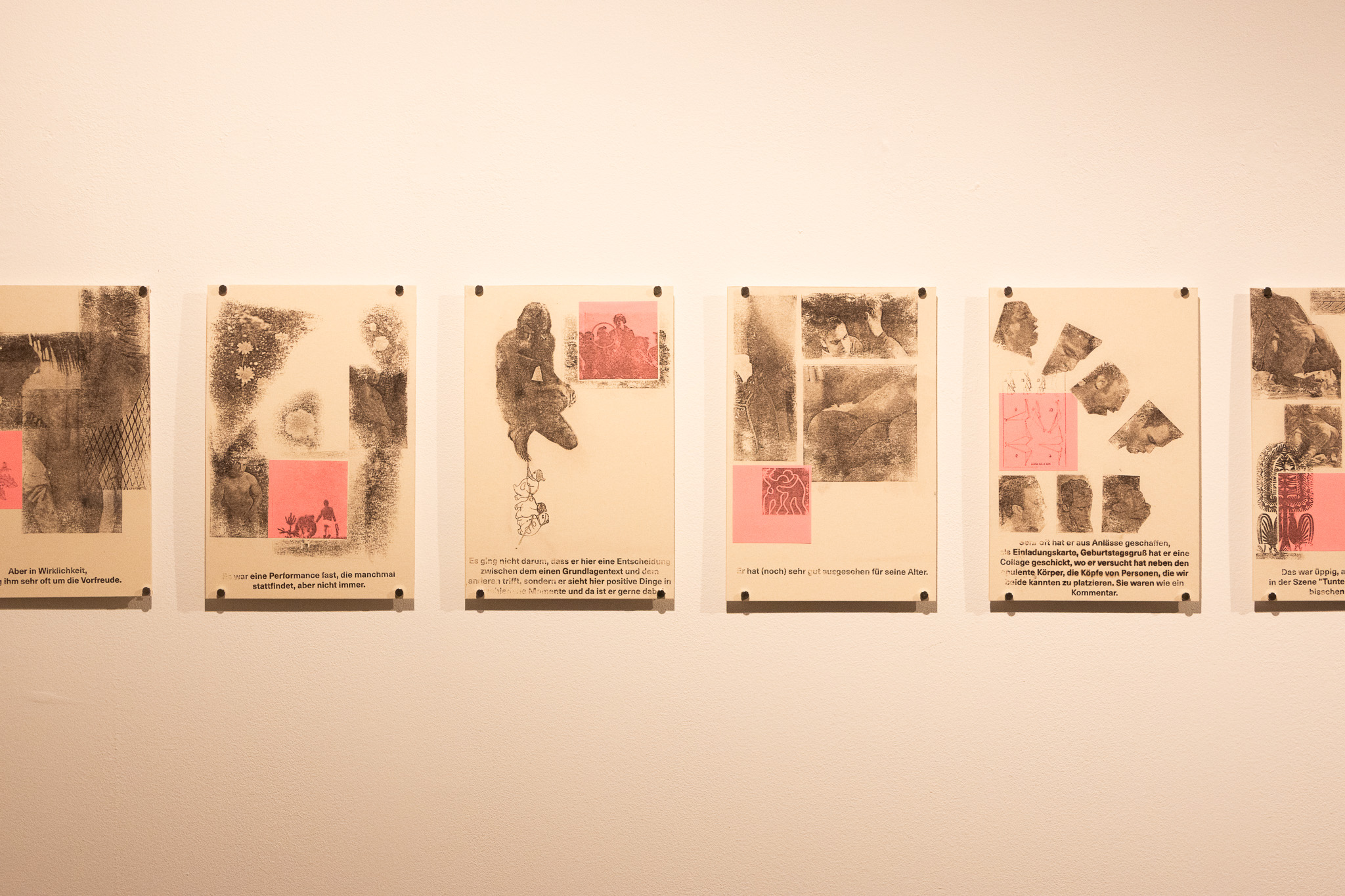
Detail, Maggessi/Morusiewicz, "Sketches" (2025-26), series of monoprints on fine carton and post-it paper. © Maggessi/Morusiewicz
Table of contents
Last edited on: August 11, 2026
Context
This presentation took place in the context of our exhibition “A Sketch for Wolfgang,” which took place from 15.01 to 01.02.2026 at QWIEN – Association for Queer Culture and History in Vienna (AT). As part of the exhibition’s accompanying program, the presentation gave insight into our research into Wolfgang Reder’s personal holdings in the context of our overall artistic-research project. For more comprehensive documentation of the exhibition, follow the link below:
Introduction
Slide #1, Presentation: "Wolfgang: A Sketch for a Present-Future Project or Between Collecting and Art-Making in a Queer Archive" (22.01.2026, QWIEN). © Guilherme Maggessi & Rafał Morusiewicz
A “still” is a single frame that stems from a video or a film. It is often used for documentation purposes, as a way to give the viewer a glimpse into a frozen moment within a moving-image work. This presentation has a similar function, as we would like to give you a few glimpses into the process, through which we started working with Wolfgang Reder’s personal estate. We will also reflect on the artistic-research questions that foregrounded and emerged out of this encounter. The process that we momentarily froze for this occasion takes place within the artistic-research project, “W/ri/gh/ting Archives through Artistic Research,” which is funded, in its entirety, by the Austrian Science Fund and is hosted by the Academy of Fine Arts Vienna. In the first part of this presentation, we will briefly introduce the conceptual-theoretical bases of our artistic-research methodology. For instance, we will pay particular attention to the sources that informed its design and to the conceptualization of two terms: “queer” (as a verb, as an adjective) and “archive.” In the second half, we will introduce our object of research (Wolfgang Reder’s estate) in the context where we encountered it (QWIEN – Zentrum für queere Kultur und Geschichte, Vienna’s queer archive). We will also talk about our research process, through which we managed to gather many biographical insights into Reder’s life and artistic activity. We will close this presentation with a brief reflection on some of the questions that we will soon face, during the development process of a research film based on the material of this investigation. We are planning to focus on that objective later this year.
Project's starting points
Slide #2, Presentation: "Wolfgang: A Sketch for a Present-Future Project or Between Collecting and Art-Making in a Queer Archive" (22.01.2026, QWIEN). © Guilherme Maggessi & Rafał Morusiewicz
Let’s start from the beginning. We are a Vienna-based duo of researching artists, academic instructors, and curators. We have worked collaboratively as “Maggessi/Morusiewicz” since 2020. In our practice, including this research project, we are interested in investigating into how the meeting of our positions complicates, in a generative way, issues that we have categorized into three main groups: (1) representation, (2) narration, and (3) medium. We think of these issues in relation to the field of artistic research, and, more specifically, artistic research that engages with archives. The first group, representation, points to our individual and blended positionalities, which are informed by the “queer” gender/sexual expressions that each of us embodies. We operationalize our positionalities by reflecting on how each of us performs one’s “queerness” through research-based practice. This, in turn, informs our topical interests and builds an emotional bias, an expectation of justice and respect, or, to use more quantifiable terms, an expectation of the equal provision of basic human rights to everyone regardless of their gender/sexual expression, self-identification, or identity. The second group, narration, helps us re-evaluate the choices of the stories that each of us is invested in telling. We ask each other about the reasons and intentions that accompany the stories that we choose to tell. The third group, medium, addresses the meeting of our medium-related interests, including the ones that each of us entered this collaboration. Before we started working together, Rafał already had an artistic practice based, to a great extent, in moving image (film and video). In their PhD in Practice project, at the Academy of Fine Arts, they worked with conceptualizing and performing artistic-research methods of engaging in the “communist” Polish cinema. At the same time, Gui was developing an artistic-research project dedicated to understanding the material conditions for the creation, presentation, and reception of a specific orientalist image housed at Vienna’s Kunsthistorisches Museum.
Project's structure & methodology
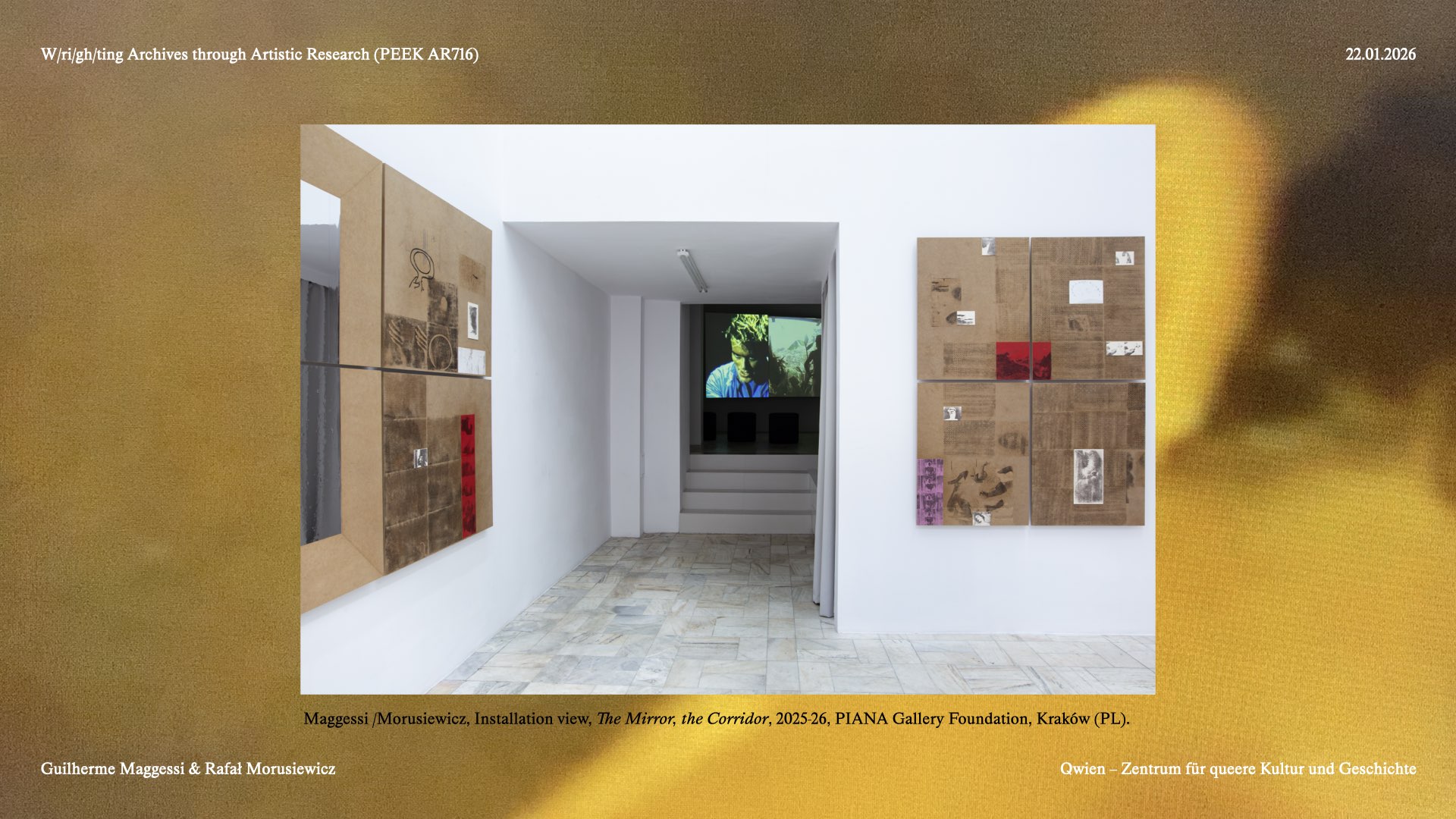
Slide #3, Presentation: "Wolfgang: A Sketch for a Present-Future Project or Between Collecting and Art-Making in a Queer Archive" (22.01.2026, QWIEN). © Guilherme Maggessi & Rafał Morusiewicz
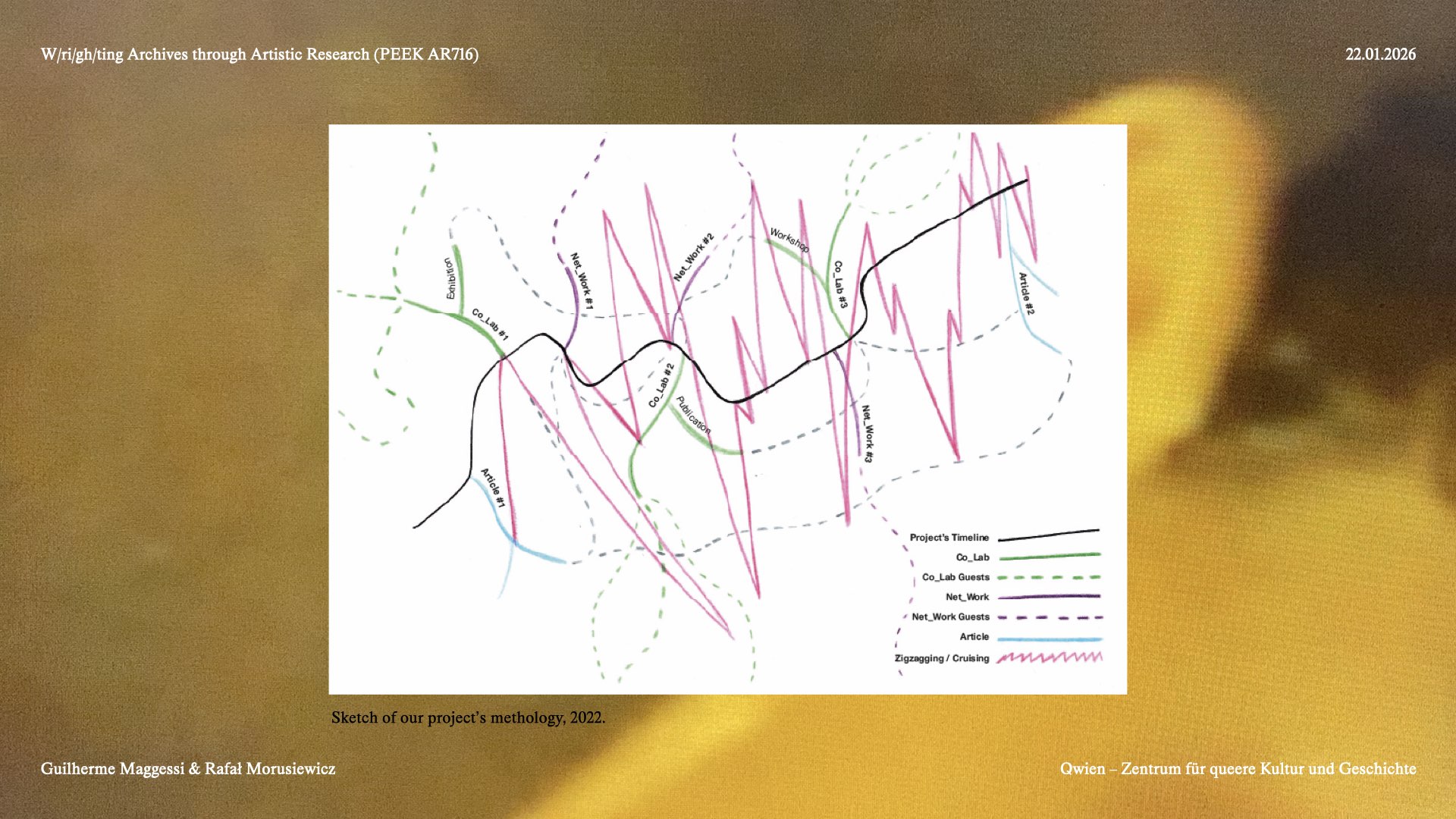
Having in mind these three themes (representation, narration, medium), we built the project’s methodology around two collaboration-based formats: Co_Labs and Net_Residencies. Co_Labs are a sequence of three several-month-long collaborative “laboratories,” co-developed with a small group of artists, cultural workers, and researchers. Each Co_Lab explores a broadly defined thematic focus. In each year of our project, we worked with “personal archives,” “queer/embodied archives,” and “resistant archives.” In relation to these topics, we selected specific artistic outcomes: exhibition, workshop, publication. Net_Residencies, which we scheduled as immediate follow-ups to the Co_Labs, play the role of a hard-reset button. In this context, we invite individual artists with a text- and sound-based artistic practice to perform the “remixing” of the generated knowledge in each Co_Lab. These are the components of our project. What is important to mention is the relationship between these components, which we describe as “non-monogamous.” Although we have specific themes and formats, we did not want to draw hard border lines between them, just as we don’t do this in between the projects that we work on, sometimes at the same time. Our idea was that we don’t want to isolate each type of archives that we investigate. On the contrary, we wanted to introduce them to each other, and, in this way, we wanted to create spaces for “promiscuous” encounters, through which we were hoping to develop and apply even more diverse artistic-research methods that would take place in the intersections between different fields, such as artistic research, queer studies, post-/de-/anti-colonial studies, applied human rights, and critical archival studies.
Slide #4, Presentation: "Wolfgang: A Sketch for a Present-Future Project or Between Collecting and Art-Making in a Queer Archive" (22.01.2026, QWIEN). © Guilherme Maggessi & Rafał Morusiewicz
All these themes and formats, together with our intention of encouraging their blending, are part of the project’s methodology. We imagined it from the start as changeable and non-linear. Thinking of the shape that such methodology could have, we came up with the term of “queer zigzagging.” Here, we were influenced by Rosi Braidotti’s notion of “critical cartography.” For Braidotti, thinking is not linear, which is visible, for instance, in the functioning of contemporary science and global economy: they create webs, they are scattered, they have not one but many centers. In order to understand their intricate mechanisms, you need to adopt non-linearity and to operate through these mechanisms via “zigzagging.” This how we think of the way we think in this project. This also relates to the way we think of time in relation to our investigation into archives. What we do is that we investigate the past from the positionality in the present, with the aim to “change the future,” so to speak.
The type of the “zigzagging” that we do in this project is “queer.” We called this method of orientation “queer zigzagging” for a few reasons. Most importantly, from project to project, we engage with “queer matters,” which also means that the methodologies that we use are inherently queer. In this project, our understanding of the adjective “queer” is informed by José Esteban Muñoz’s work, including his description of “cruising.” Cruising is a movement or a motion that happens through a disorientation of both time and space, which Muñoz analyzes in his proposal of “queer utopia.” This utopia, as every utopia, always remains “in the horizon”; it is never here, in the present. For Muñoz, a queer utopian project is placed and is interested in the margins or the fringes of political and cultural production, in the margins of what he calls “the tyranny of the homonormative.” What he proposes is not to imagine to “an isolated future for the individual.” Instead, he writes about the idea of collective participation in what he calls “a hermeneutic that … describe[s] a collective futurity” and, from this angle, it “functions as a historical materialist critique.”
Muñoz focuses on the non-normative strangeness of queer experience, which is a quality that is also present in Wendelin Küpers’s article, titled: “Queer(ing) Moves: Beyond Anthropocene, Toward Convivial, Sustainable Futures.” Küpers uses the word “queer” as an adjective and as a verb. “Queer” as an adjective may mean many things. in this context, two are particularly important: (1) “weird” – to describe something that doesn’t belong; and (2) “eerie” (unheimlich) – something that is present, which means that it is expected to be absent and fails to do so. Küpers also uses “queer” as a verb: “to queer” means to express one’s suspicion against modes of thinking along linear narratives and clean-cut binary categories. “To queer” something may also produce a weird temporality, one that is both past and present, or one that happens “in-between” or “in-the-meantime.” In our project, we think of the word “queer” both as an adjective and as a verb, and we use it as a declaration of our ongoing focus and attention. Queering means looking for anomalies, objects, and ideas that would keep us on our toes, that would cause us conceptual headaches, writer blocks, and other crises.
The "archive"
Slide #5, Presentation: "Wolfgang: A Sketch for a Present-Future Project or Between Collecting and Art-Making in a Queer Archive" (22.01.2026, QWIEN). © Guilherme Maggessi & Rafał Morusiewicz
This was a summary of our objectives, intentions, and methodological orientations that accompanied us at the moment of meeting Wolfgang Reder’s personal archive, which has been hosted and stored here at QWIEN. But before we move, let’s unpack one last key term, i.e. “archive.” All of the keywords, methods, and orientations that we have discussed are in a relationship to the notion of “archive,” which we think of as a “notion” rather than a “concept.” Why and how does this matter? It is a distinction proposed by Sara Callahan. She claims that, for her as a researcher, “archive” is a “notion” rather than a “concept,” because she thinks of archives as organisms that are quite possibly vague. For her, the word “archive” does not present itself through a unified and clearly defined set of ideas. Instead, she prefers to define the word “archive” in relational terms. Apart from objects, buildings, and people working in archiving institutions, such as QWIEN, archives are also defined by the “inclination, impulse, or intention” of anyone, a researcher, an artist, a researching artist, who interacts with them.
Slide #6, Presentation: "Wolfgang: A Sketch for a Present-Future Project or Between Collecting and Art-Making in a Queer Archive" (22.01.2026, QWIEN). © Guilherme Maggessi & Rafał Morusiewicz
Sara Callahan references here Mieke Bal’s description of “traveling concepts.” Concepts, the theory that they produce, and the practices that these theories are put to, all of them are influenced by the “travel” that they do between “disciplines, … individual scholars, … historical periods, and … geographically dispersed academic communities.”
An interesting nuance to this understanding of what “archives” are is added by Julietta Singh, who writes about the “stakes” of doing archival research, i.e. on the institutionally reinforced “intellectual desire” that is present in one’s intention (internally) and declaration (externally) of engaging in archive-based research within academia. Singh describes the mechanisms that condition researchers to call what they study an “archive”: this happens because of the desire to add externally recognized value to one’s object of research, and, in this way, to justify one’s “belonging” in academia. Julietta Singh’s definition demonstrates suspicion or ambivalence about the very idea of “archives,” which hints at the existence of possible violence at their core. Such violence may happen through mechanisms of inclusion and exclusion, through the decisions that people working in archives need to take about what is and what isn’t worthy of preservation.
This ambivalence is one of the core interests within critical archive studies: Michelle Caswell addresses it with the following questions: “Who has the power to create records? Who has the power to preserve them? What resources (financial and temporal) are required to care for them? What forms of expertise? … [W]ho gets to access them and why? … [W]ho cannot access them and why?”
Slide #7, Presentation: "Wolfgang: A Sketch for a Present-Future Project or Between Collecting and Art-Making in a Queer Archive" (22.01.2026, QWIEN). © Guilherme Maggessi & Rafał Morusiewicz
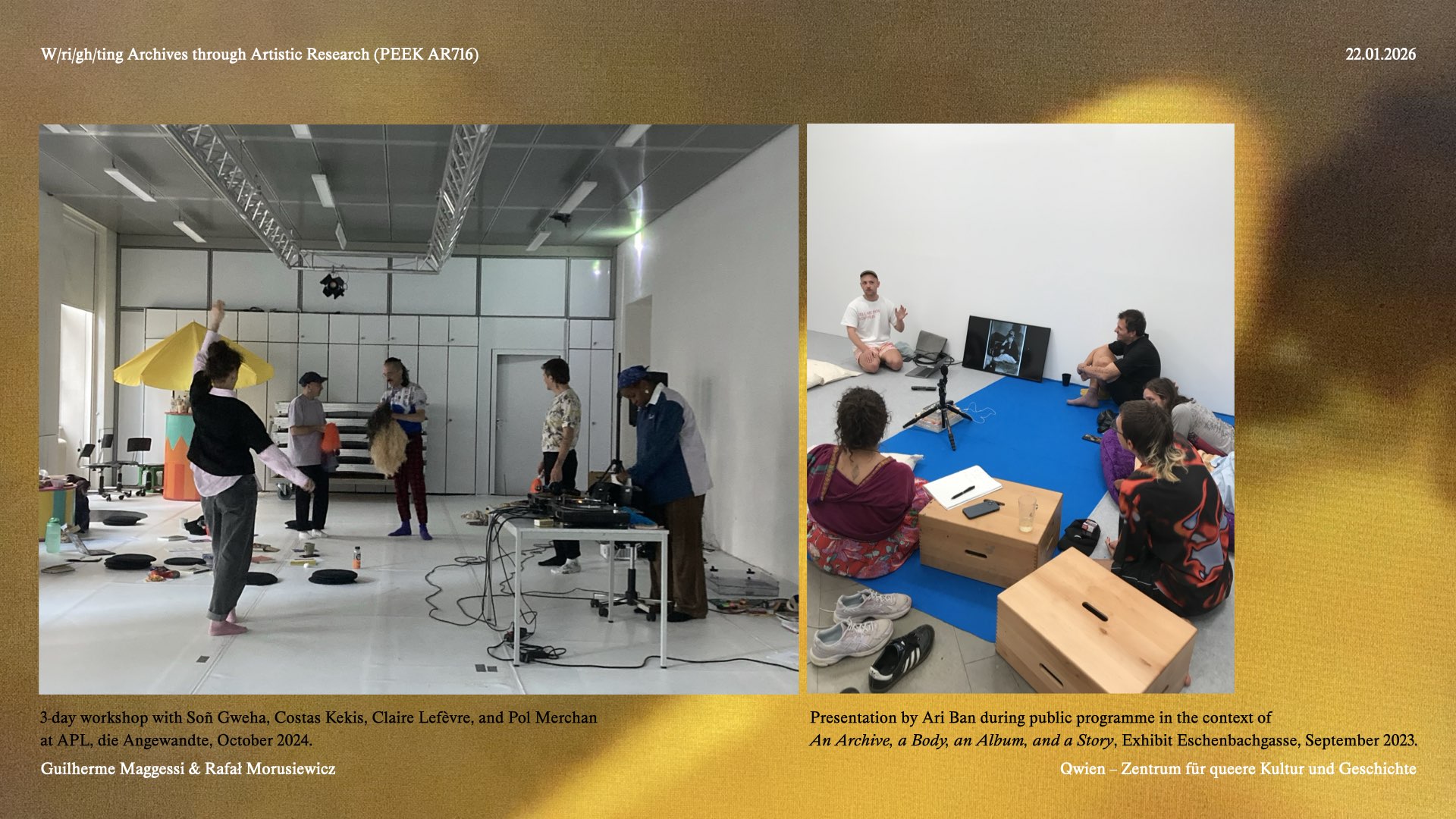
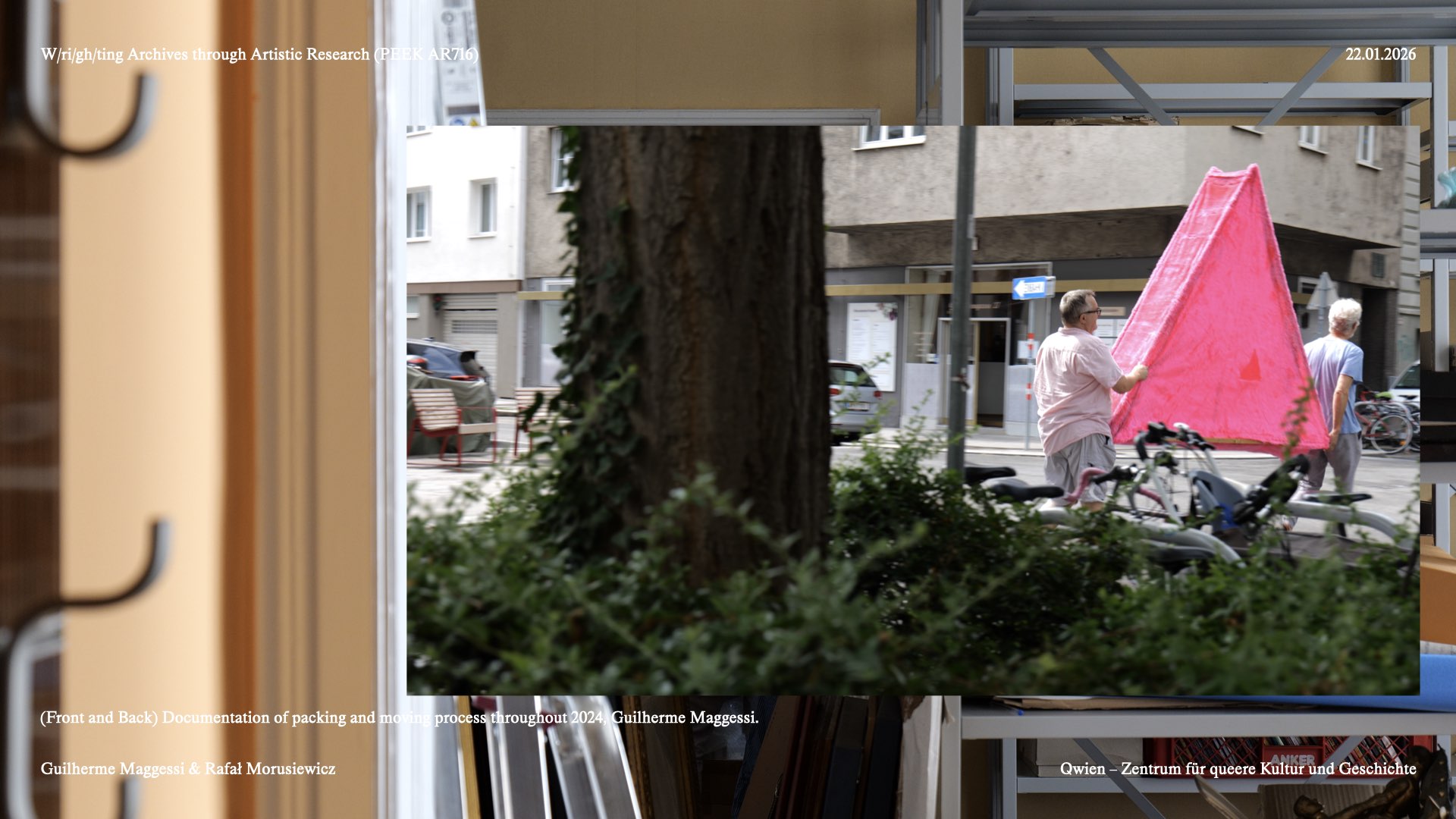
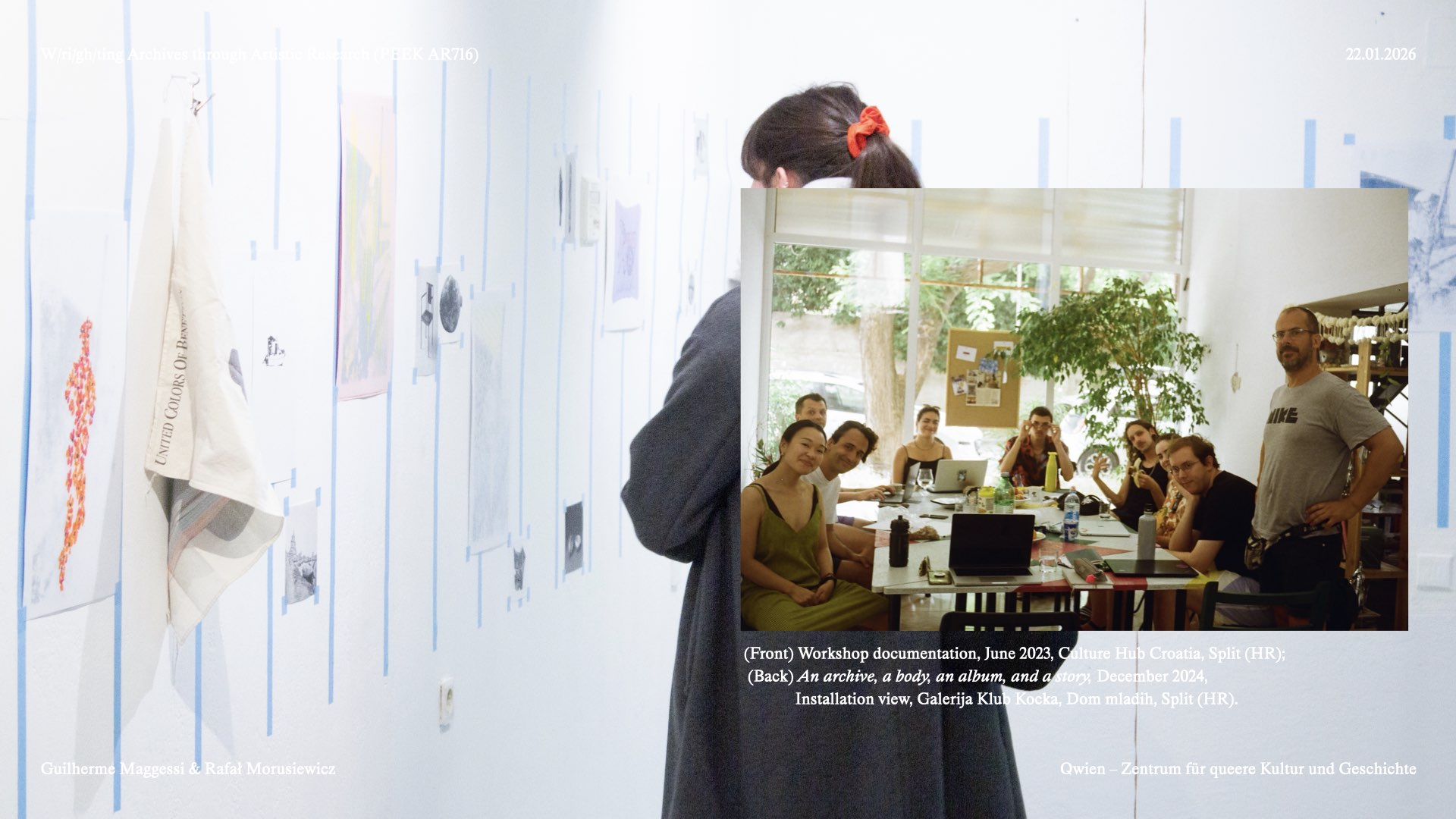
All this is an important epistemological framework, through which we started our engagement into the project’s Co_Labs, which is a short name for “collaborative laboratories.” In this format, we wanted to collaborate not only with individual artists, researchers, collectives, and organisations, but also with their “archives,” their collections of material objects, ephemera, tchotchkes, and memories, which they deem to be worthy of preservation. Each Co_Lab started with an assumption around the modality of its core collaboration. In the first Co_Lab, for instance, we worked closely with queerANarchive in Split (HR), represented by Tonči Krajnčevič Batalič, and, together with several artists, researchers, and cultural producers, we held a series of workshops, leading toward a collaborative exhibition. In this case, the research tool that we used consistently was “artistic assignments,” which is a practice that relates to the activity of the Fluxus group. Choosing this format helped us structure a several-month-long investigation about what it means to think that an object, material or immaterial, is part of your personal archive. This Co_Lab was built around the process that started from this ontological question. Only by trying to answer it, we were able to move on to progressively more specific questions and practices.
Meeting Wolfgang
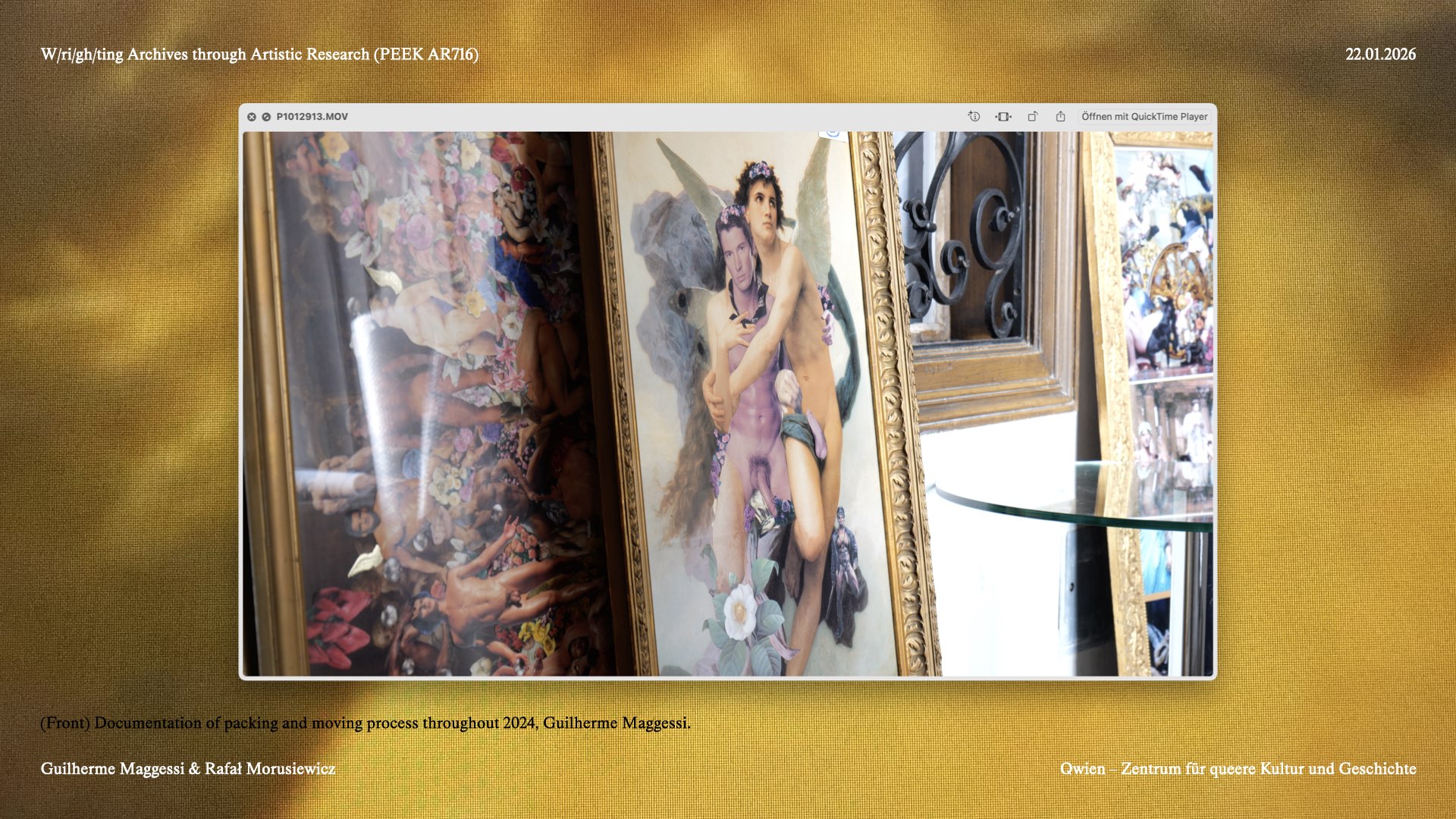
Slide #8, Presentation: "Wolfgang: A Sketch for a Present-Future Project or Between Collecting and Art-Making in a Queer Archive" (22.01.2026, QWIEN). © Guilherme Maggessi & Rafał Morusiewicz
In the second Co_Lab, the one where we shifted to QWIEN and to the estate of Wolfgang Reder (1946–2017), we started differently. We started from the identification of a very specific set of objects and a very specific agenda of rescuing them, by the process of digitization, from destruction.
Our encounter with Wolfgang Reder happened in early 2024, in one of the three crowded flats in an old tenement residential house, which QWIEN rented until their move to the current location. The meeting happened thanks to Andreas Brunner, Hannes Sulzenbacher, and Thomas Tretzmüller, who gently ushered us toward Wolfgang’s holdings, responding, in this way, to our declaration of help with systematizing and digitizing some of QWIEN’s collections.
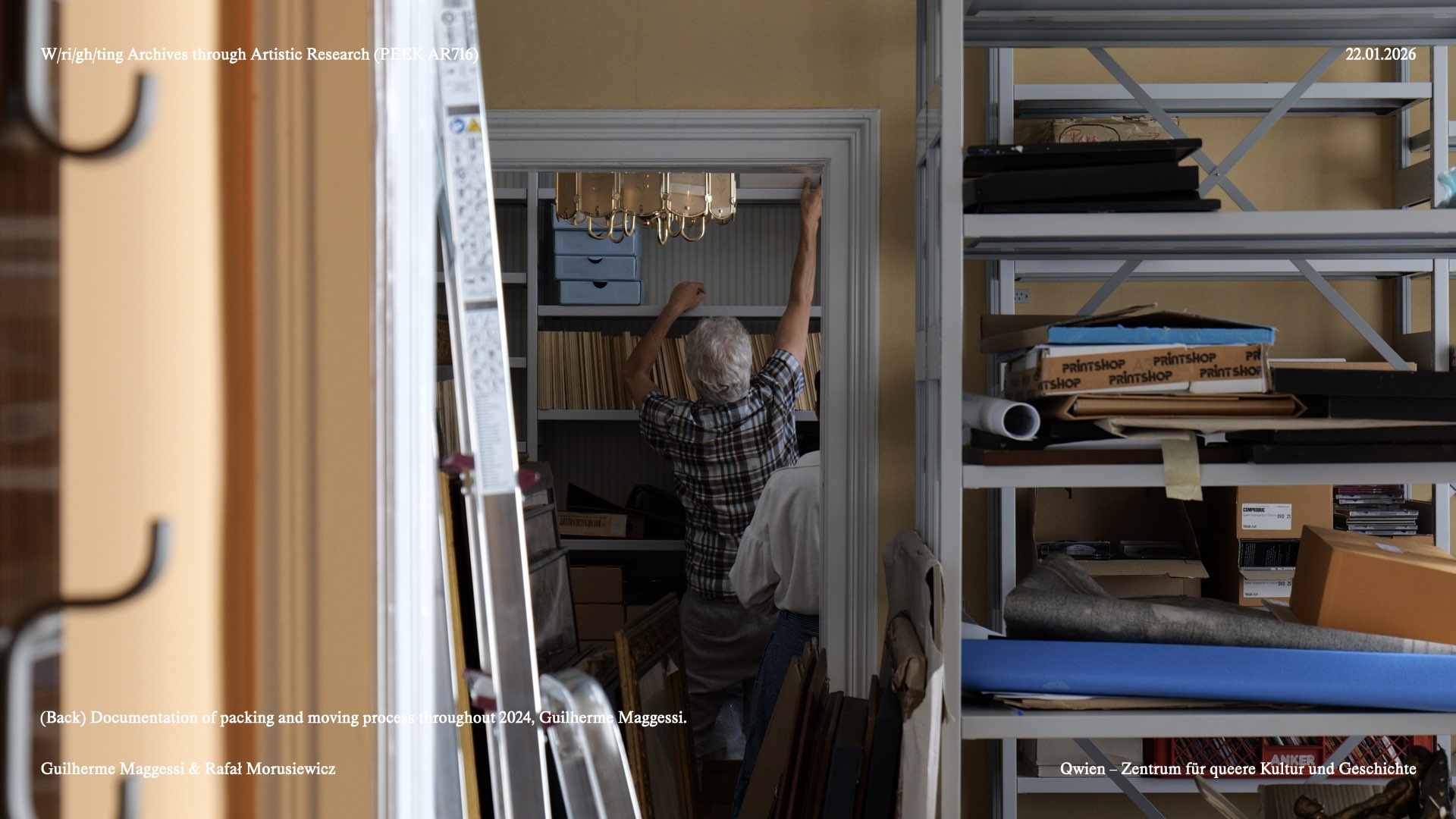
Wolfgang Reder’s collection at QWIEN encompasses (1) 72 binders (ca. 200 pages each), (2) many artworks, including printed and framed analogue and digital collages, (3) a hard drive with a bit over 1TB of data, and (4) a mid-size acid-free box containing documents, letters, and drawings made, among others, by his daughter, Alice Reder. While we initially planned to tend to all of them, our inquiry started and ultimately ended with the set of binders, which Reder filled, most likely throughout the 1990s, with elaborate image-based query and drafts of collage works, which showed images representative of mainstream gay pornography, visual material of AIDS-awareness campaigns, and fashion ads. We started the digitization process with the binders, as they seemed in the most dire need of restoration or preservation: they consist of paper cut-outs from books and magazines, glued onto paper, and stacked in plastic covers. We knew that scanning each page would likely destroy some of the material, so instead we used a digital video camera, we placed it overhead, on a table, and filmed us flipping through each binder, page by page. Having exported the recorded footage into multiple documentation videos, we started the process of isolating stills, one pair per each double spread, as TIFF files, which will be soon converted to PDF files, so that the text, handwritten by Reder and imprinted in the layout of many images, could be searchable. When we are done with the exporting work, this material will become our contribution to QWIEN’s dataset collections.
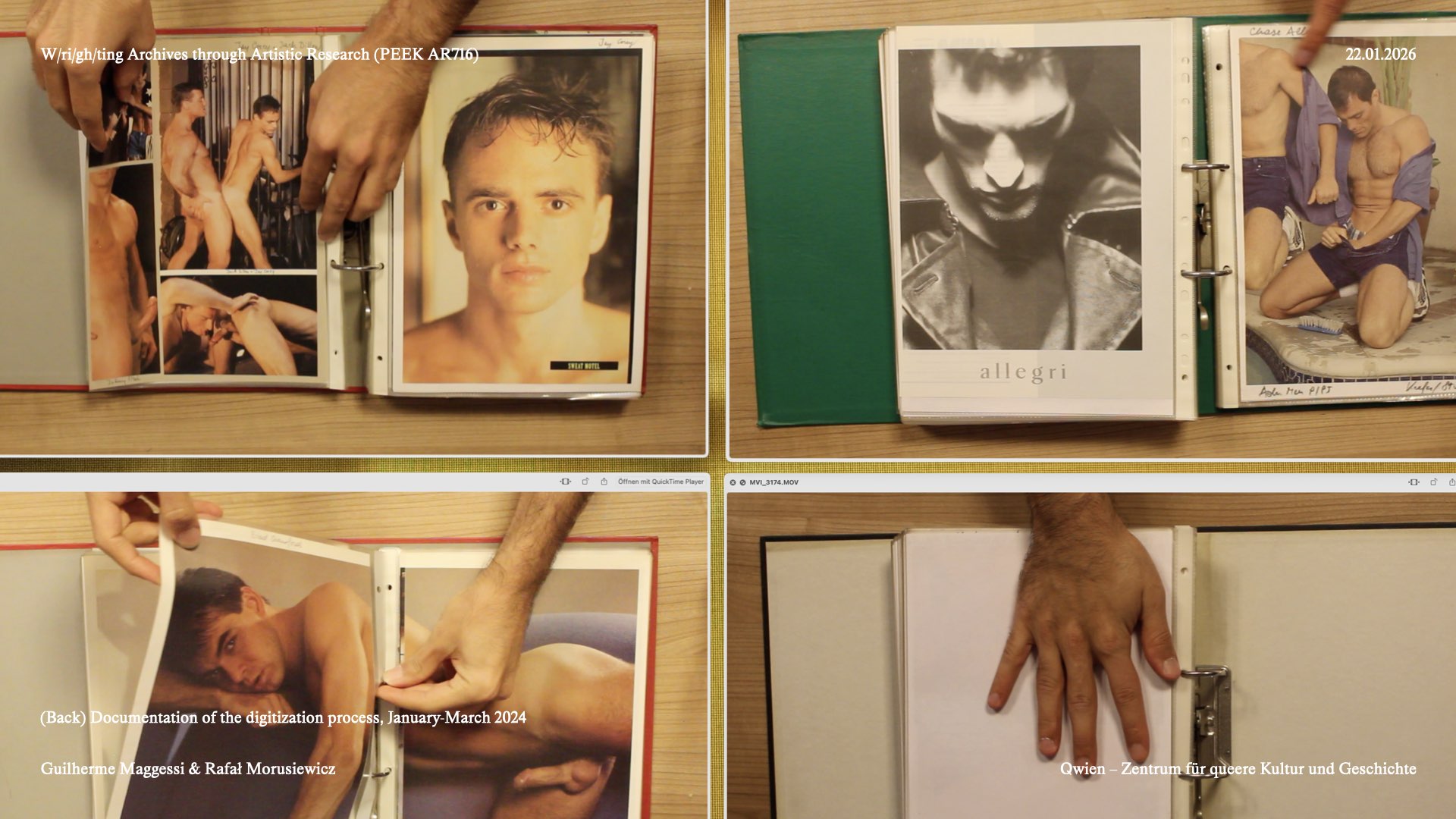
Slide #9, Presentation: "Wolfgang: A Sketch for a Present-Future Project or Between Collecting and Art-Making in a Queer Archive" (22.01.2026, QWIEN). © Guilherme Maggessi & Rafał Morusiewicz
Through the monotonous digitization process of Reder’s binders, we developed curiosity to investigate into the origins of this unusual collection and his collaging artistic practice. His external hard drive demonstrated his shift from working with paper cut-outs to digital collaging with the use of Photoshop. The drive offered us insight into other elements of his life, including the fact that he had a daughter, who lived in Warsaw. With some hesitation, we initiated a meeting with her, as well as with a few of his Vienna-based friends. We did not plan this to become an oral-history project, yet this is where we landed because of our curiosity about Reder’s artistic practice, which happened along his life circumstances. Throughout 2024, we arranged audio-recording sessions with five people in Vienna (Manfred Neuwirth, Stefan Zeisler, Rudolf Katzer, Niko Wahl, and Michael Eder), as well as with two people outside Vienna: his daughter, Alice Reder, in Warsaw, and his life partner in the 1980s–1990s, Piotr Glados in Hamburg. Initially, we wanted to talk about Wolfgang’s collection and his working process, so that we could contextualize it. However, after a few months, we realized that we had already started a bigger investigation into many contexts in which Wolfgang lived and which he also created. The stories that came up during the conversations gave us fascinating insights into the lives of a gay community in Vienna at the turn of the 20th–21st century, and also into the almost two decades of his life that he spent when living in communist Poland (since the early 1970s until the mid-1980s).
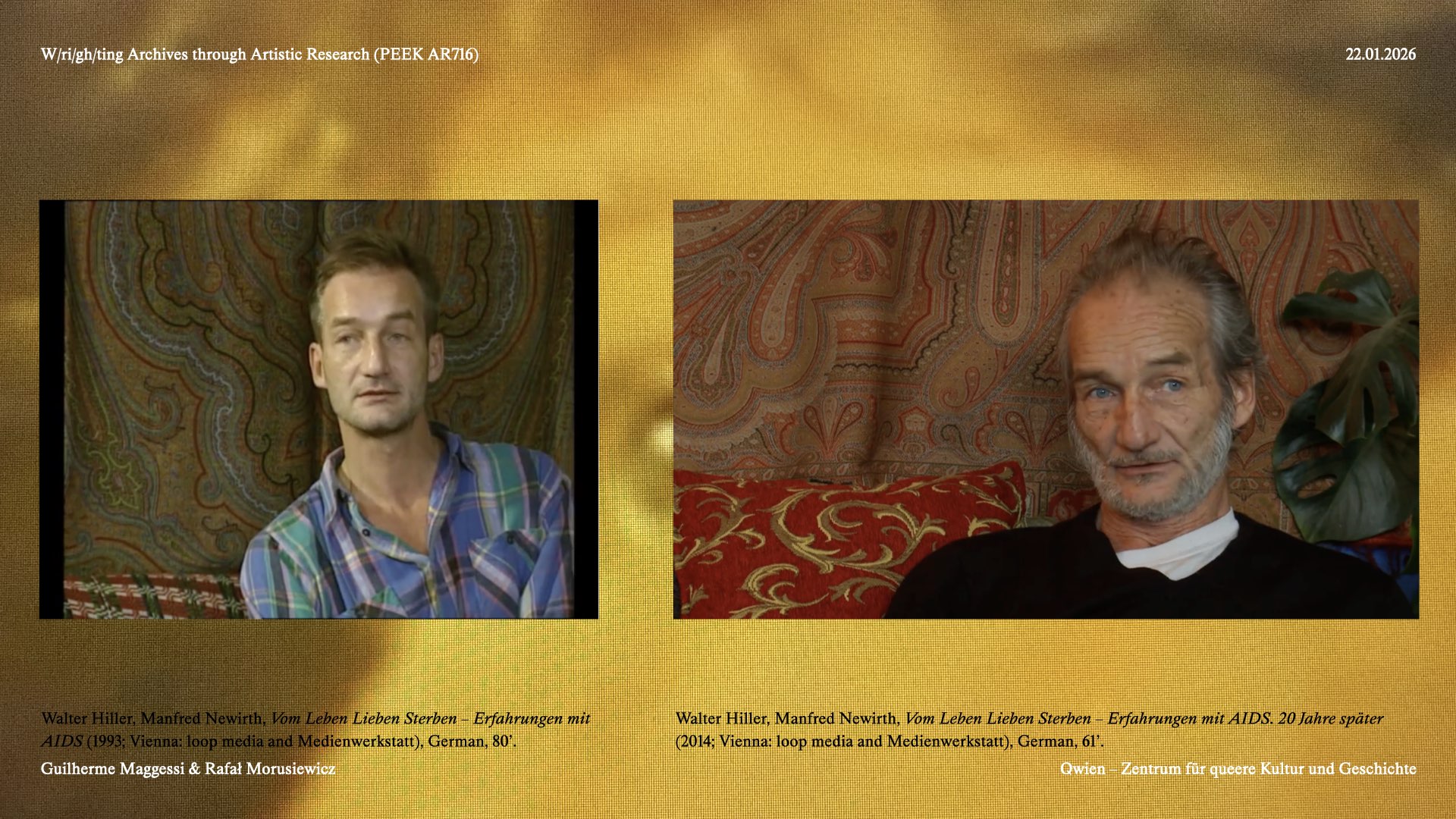
Slide #10, Presentation: "Wolfgang: A Sketch for a Present-Future Project or Between Collecting and Art-Making in a Queer Archive" (22.01.2026, QWIEN). © Guilherme Maggessi & Rafał Morusiewicz
These conversations made us aware of many interesting contexts. For instance, Manfred Neuwirth, for instance, helped us contextualize the documentary film “Vom Leben Lieben Sterben – Erfahrungen mit AIDS” (dir. Walter Hiller & Manfred Neuwirth, 1993), which features Reder’s testimony about, among others, his work as a “Buddy” with the clients of Vienna’s AIDS Hilfe. Neuwirth also co-directed the film’s sequel “Vom Leben Lieben Sterben – Erfahrungen mit AIDS – 20 Jahre später” (dir. Walter Hiller & Manfred Neuwirth, 2013), through which we learned that Wolfgang was HIV positive during his life’s last decade or so. Importantly, these are the only two video interviews of his that we have reached so far.
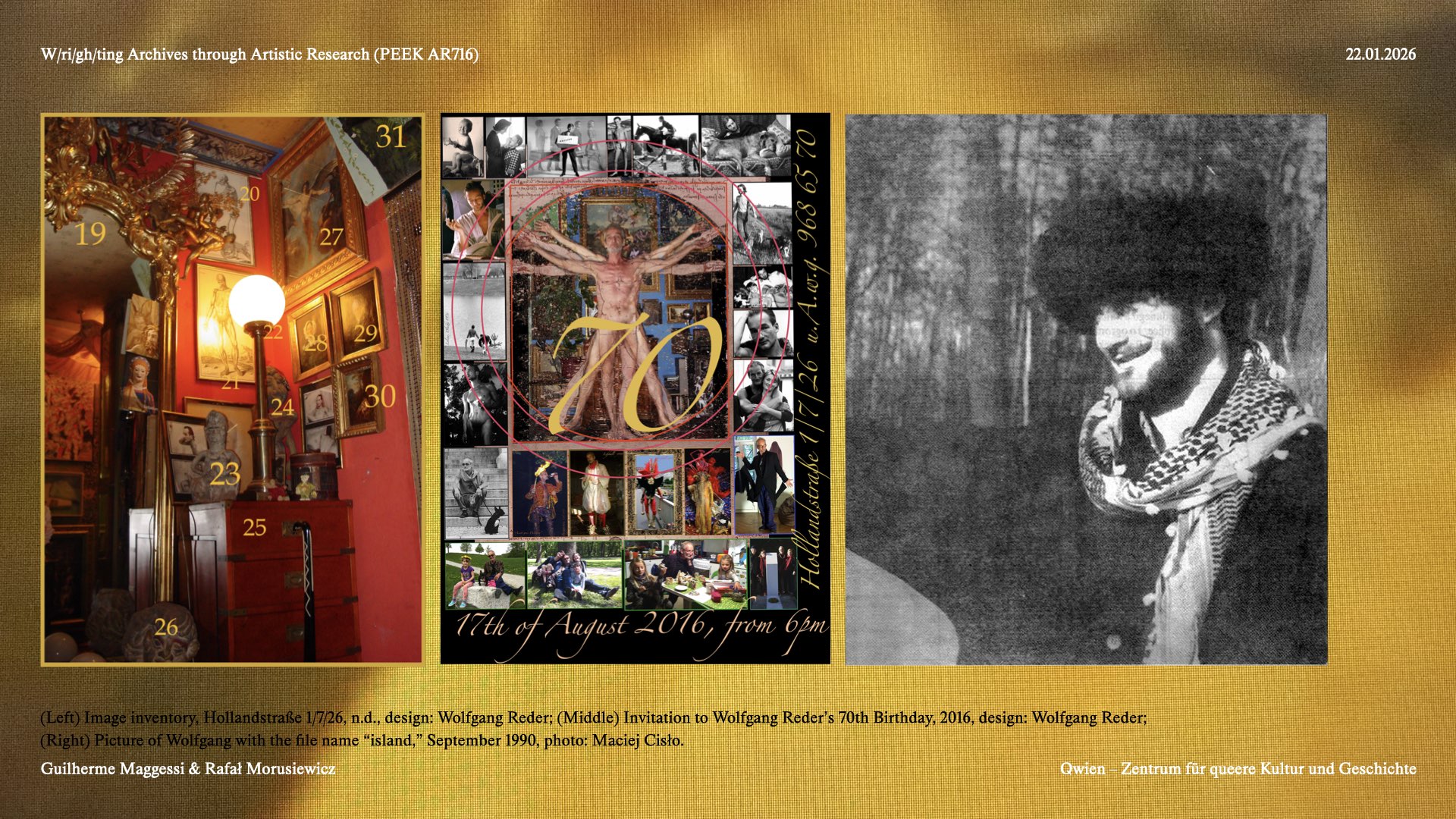
Slide #11, Presentation: "Wolfgang: A Sketch for a Present-Future Project or Between Collecting and Art-Making in a Queer Archive" (22.01.2026, QWIEN). © Guilherme Maggessi & Rafał Morusiewicz
With every conversation, more details would come out, bringing us closer to consolidating a chronological biography of Reder’s life in Poland, in Vienna, and several in-between locations. We started thinking of him as a person with other people in his life, something that we didn’t think of much, while we were going, page by page, through each of his folders. We didn’t think of it when we took many breaks to change or charge the camera’s batteries and to empty the SD cards whose storage would fill up after each few folders. While we had seen a few photos of his flat on his external hard drive, we found out only later, thanks to his daughter, that the precise description of the many, many objects that he stored there was possibly the result of his anticipation of death. Wolfgang also wrote and hand-made a zine-like autobiography, which included newspaper articles, photographs, and transcribed letters. We heard multiple anecdotes about Wolfgang’s birthday parties that he held in his small flat in Vienna’s 20th district, which overlooked the Danube canal with a terrace filled with so many plants that it was visible from a distance like a juicy green blob, which stood out among the other drab-looking neighboring windows. The parties that he threw were announced with customized postcards, which displayed his passion for gay-erotica collages, as did his toilet, whose walls were plastered with tons of images of naked men, happily displaying their soft or hard penises. What particularly impressed the people that we talked to about the mosaic in the toilet was that he had considered and included the human-eye looking perspective: he used different image sizes, which would grow proportionately to the distance away from the toilet seat, which was the assumed position of looking. The toilet was representative of the flat, described as baroque, romantic, excessive, filled with collages, tons of collected pictures and paintings, textiles thrifted in second-hand shops and flea markets.
Slide #12, Presentation: "Wolfgang: A Sketch for a Present-Future Project or Between Collecting and Art-Making in a Queer Archive" (22.01.2026, QWIEN). © Guilherme Maggessi & Rafał Morusiewicz
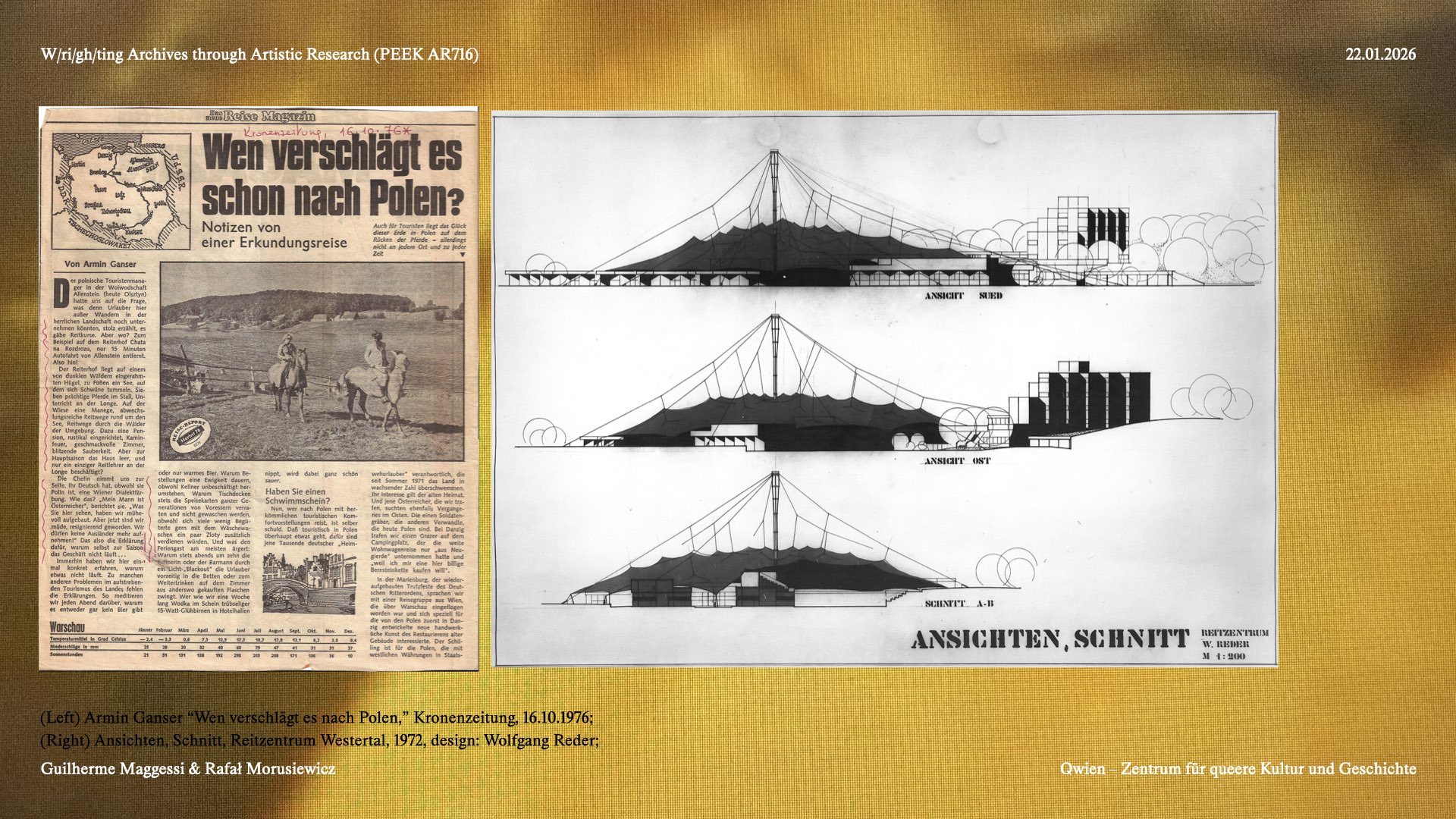
The earliest mentions of Wolfgang’s artistic practice that we have gathered so far date back to Poland, where he went, for the first time, in his early 20s, as a student of architecture, on a trip to take a horse-riding course. Alice told us that his youth was carefree. He grew up in Vienna, he would go to the city’s opera house and he dated beautiful girls. During this trip, he met the woman who ran the horse-riding school. They fell in love, got married, and had a daughter. Supposedly, he also fell in love with communist Poland. As he states in Hiller & Neuwirth’s 1993 film, he spent his “happiest years in deep communism.” Reder lived in the Polish countryside for around a decade, during which he struggled, as his daughter recalls, particularly during harsh winters, with the daily mundane hardship of tending to oft-ailing horses, milking cows, making stove fire, and conducting repairs of countless things that would constantly break down.
Slide #13, Presentation: "Wolfgang: A Sketch for a Present-Future Project or Between Collecting and Art-Making in a Queer Archive" (22.01.2026, QWIEN). © Guilherme Maggessi & Rafał Morusiewicz
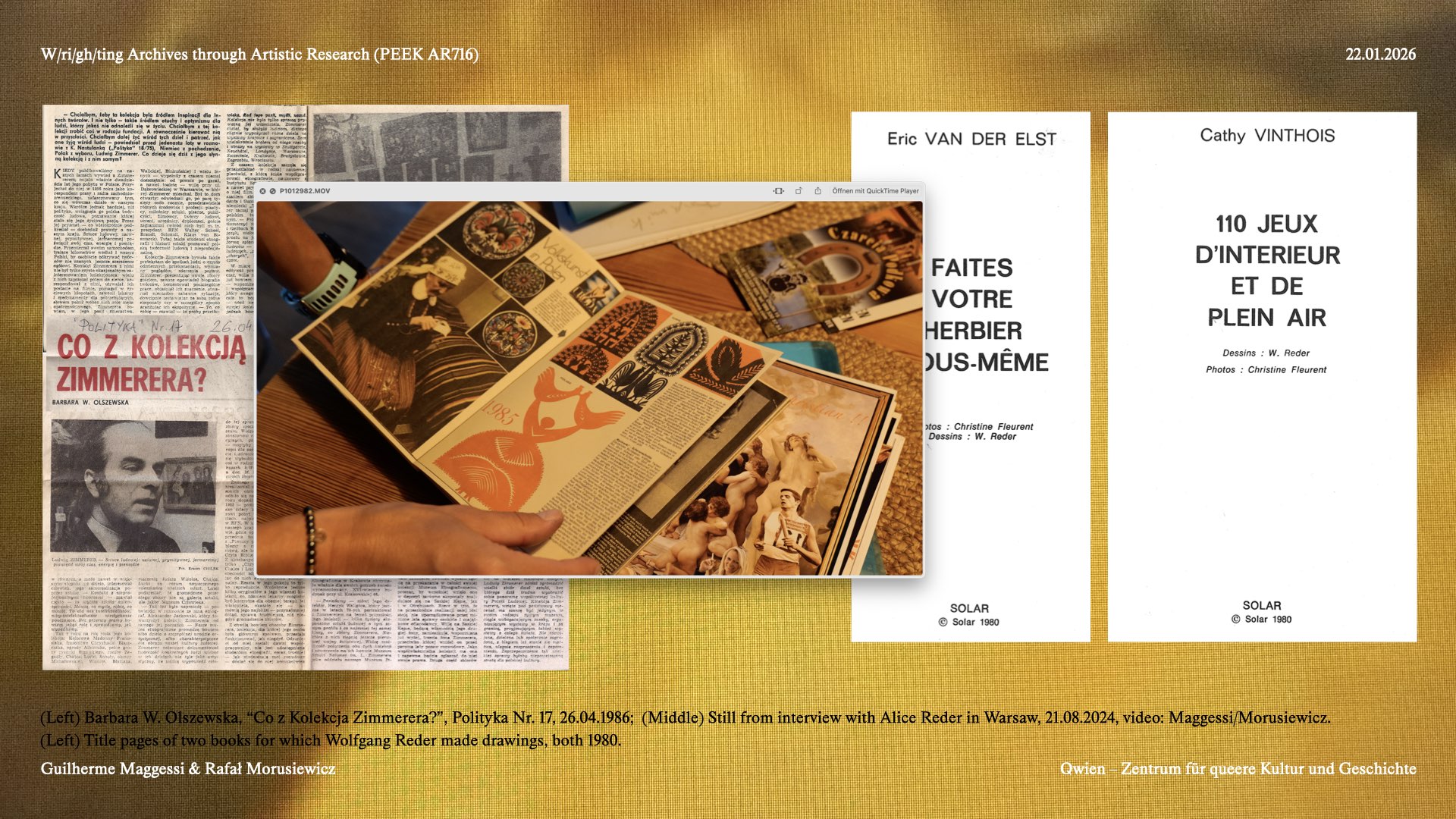
In the late-1970s, he started traveling to Warsaw. He started working for journalist Ludwig Zimmerer, a prominent figure in the management of the German-Polish political relationships, who was also a private folk-art collector. Wolfgang’s job consisted in tending to this collection. In this context, he met Piotr Glados, the editor-in-chief of “Poznaj swój kraj” (“Get to Know Your Country”), a popular state-controlled monthly magazine, dedicated to school tourism and tourism clubs, including recreational regional and provincial activity, such as folk artistic practices. Wolfgang and Piotr developed an interest in each other, first professional, then romantic-sexual, consolidated by their shared interest in traveling the Polish countryside and meeting local artists. Part of Zimmerer’s activity was buying their art and providing them with support infrastructure. At that time, both of them were married, and both of them soon got divorced. Wolfgang moved to Warsaw and lived there until 1986, when he was ordered to leave Poland for his anti-communist-state political activity. Piotr decided that he would leave with Wolfgang too, which brought an end to his stable professional career. Wolfgang did not want to move back to Vienna, both of them chose Hamburg. Piotr spent a few weeks in a transit camp, then he got registered in Hamburg. And Wolfgang’s life stretched, for a few years, between Hamburg, where he unsuccessfully tried to settle together with Glados, and Vienna, where he eventually ended up living until his death in 2017. Piotr Glados lives currently in between Hamburg and Katowice. Alice Reder lives in Warsaw. Most of the biographical information that we have mentioned are based on the several conversations that we have conducted with both of them.
The process within our practice
Slide #14, Presentation: "Wolfgang: A Sketch for a Present-Future Project or Between Collecting and Art-Making in a Queer Archive" (22.01.2026, QWIEN). © Guilherme Maggessi & Rafał Morusiewicz
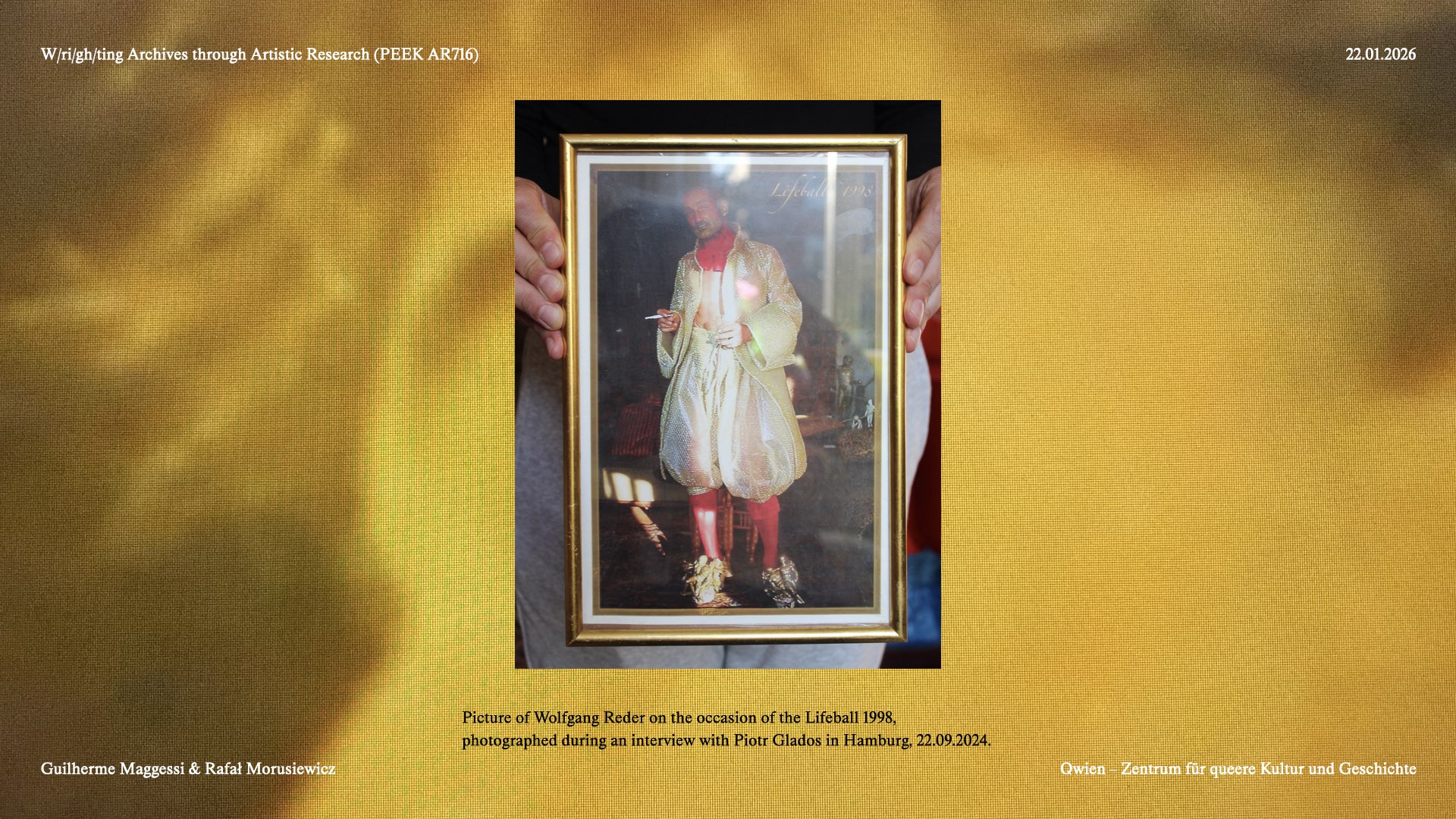
This presentation is a description of the process that we have frozen, like a film still, for this occasion. While we have expressed interest in making an “experimental essay film” around Reder and his estate, we still face numerous questions, some of which pertain to our basic intention. What do we want from Wolfgang Reder? Or, more precisely, what are the artistic-research film-based practices and gestures, through which we want to and can express this intention and process the material that we have collected? In the introductory phone call in the summer of 2024, Piotr Glados expressed his concern about Reder’s life being presented through his collages, i.e. through the perspective of thousands of images of nude cis-men presenting their hard or soft penises, which may have already dominated the common perception of Wolfgang’s artistic practice. Initially, we reacted to Piotr’s concern with slight confusion, which then turned into a deeper question concerning our own practice.
Slide #15, Presentation: "Wolfgang: A Sketch for a Present-Future Project or Between Collecting and Art-Making in a Queer Archive" (22.01.2026, QWIEN). © Guilherme Maggessi & Rafał Morusiewicz
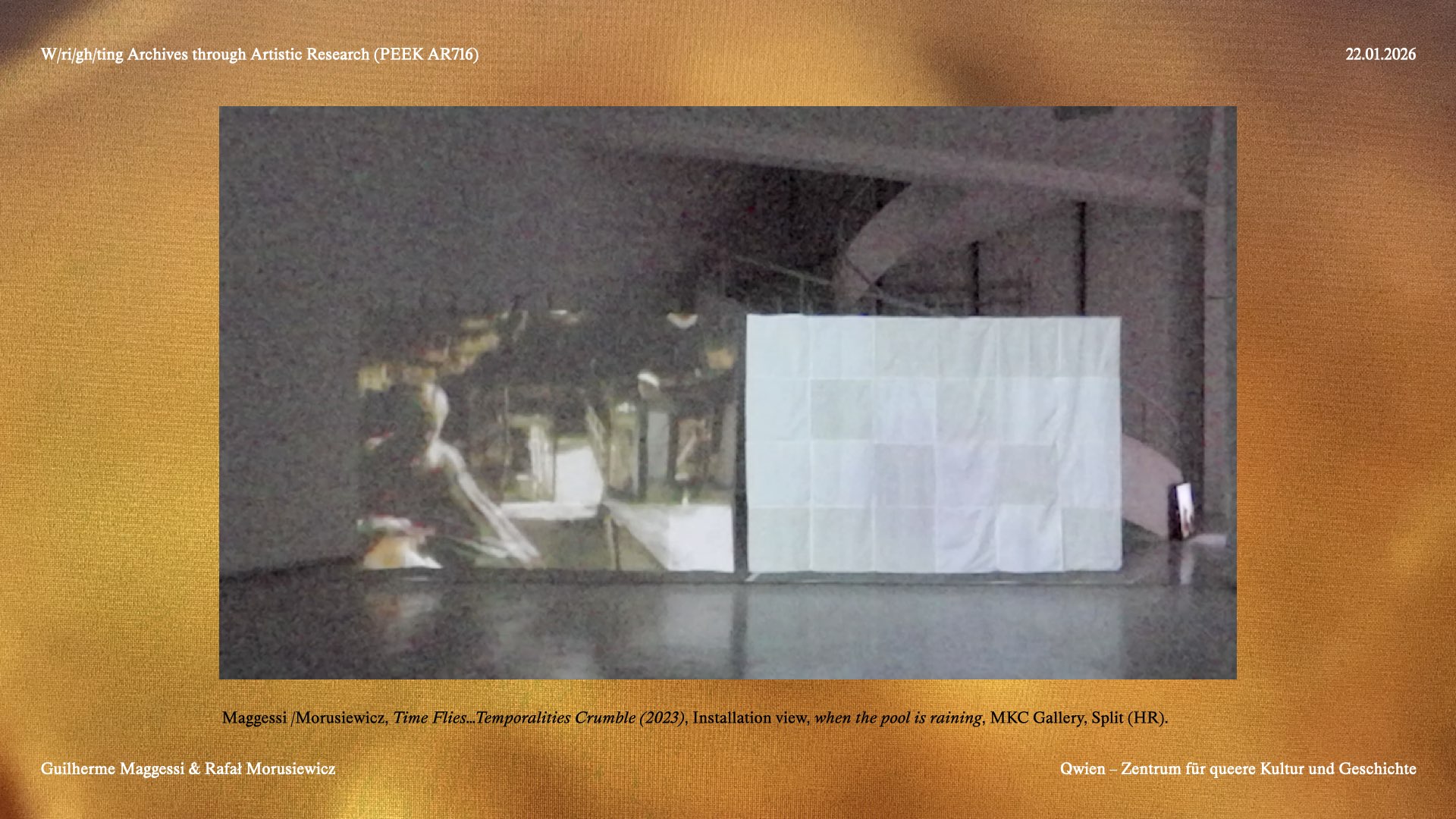
In parallel to this project, we have been engaged in another project, one that still continues with an exhibition that we have in Krakow. If you happen to be in Krakow next week, we will have an artist talk and the finissage on Friday and Saturday. The project is called “Wormholes,” and part of it also focused on “cis naked men with penises,” as it relates, among others, to the archives of pre-AIDS gay-art porn films. In the Wormholes project, our critical analysis focuses on the film scenes that feature everything else but sexual acts, but all the “penises” are still there, no matter if they are present explicitly or elliptically. And it is the presence of “all these penises” that initiated our research into the narrative modes in these films, which are special when compared to later pornographic films, because their protagonists spend a lot of time not only doing sex, which, in this project, we are less interested in, but they do a lot of other activities. Sometimes, they just hang around, doing things alone or with other people. They go for walks, they walk their dogs, they eat breakfasts. Apart from all the sex scenes they have, they also have a life.
Watching these films, we thought of Muñoz’s “queer utopia” project. We noticed how this relaxed pace of storytelling suddenly disappears in later-time gay-porn films, but it comes back again in more recent ethical-queer-porn films, produced by film studios such as Pink and White Productions, AORTA Films, altSHIFT Films, and Himeros.TV. We have a gut feeling that maybe this more relaxed porn temporality has something to do with critique of neoliberal-capitalism, as it edges the viewers’ attention, and it driving the attention away from the intercourse and the obligatory cum-shot-scene conclusion. These films make us think of the description of Wolfgang’s practice of collecting pornographic images that Alice gave us. Alice said that Wolfgang had a day routine: he would wake up not super early, he would drink capuccino, he would walk the dogs, and then he would have a glass of Gurktaler and he would spend one or two hours by playing around with the images of, how she called it, “naked boys.” In these two contexts, we are thinking of what is conventionally thought of as “unproductive” time.
Slide #16, Presentation: "Wolfgang: A Sketch for a Present-Future Project or Between Collecting and Art-Making in a Queer Archive" (22.01.2026, QWIEN). © Guilherme Maggessi & Rafał Morusiewicz
How can this material, comprising of so many images of (mostly) gay cis-male desire, be examined for the purpose of demonstrating the specific situatedness of his life, his gaze, his practice? How can the element of daily-routine practice, saturated with sexual desire and sexual activity, be represented in relation to our collaborative artistic engagement with his work? As GVGK Tang postulates in the context of pornography-based archival research, archivists need to view themselves as “people who assume the celebrated ‘role in actively shaping collective (or social) memory,’” which may be challenging in complex, intimate contexts like this one, where “pornography intersects with identity and community.” We hope to continue defining and holding this role through the future film project dedicated to Wolfgang Reder.